
Vacuum Homogenizing Emulsifier: How to Choose the Right One
A vacuum emulsifier does two jobs at once: it keeps the batch under negative pressure so air cannot be whipped in, and it forces the oil and water phases through a rotor-stator gap until the droplets are small enough to stay suspended. Which machine you need depends on batch size, product viscosity and how often you clean between formulas.
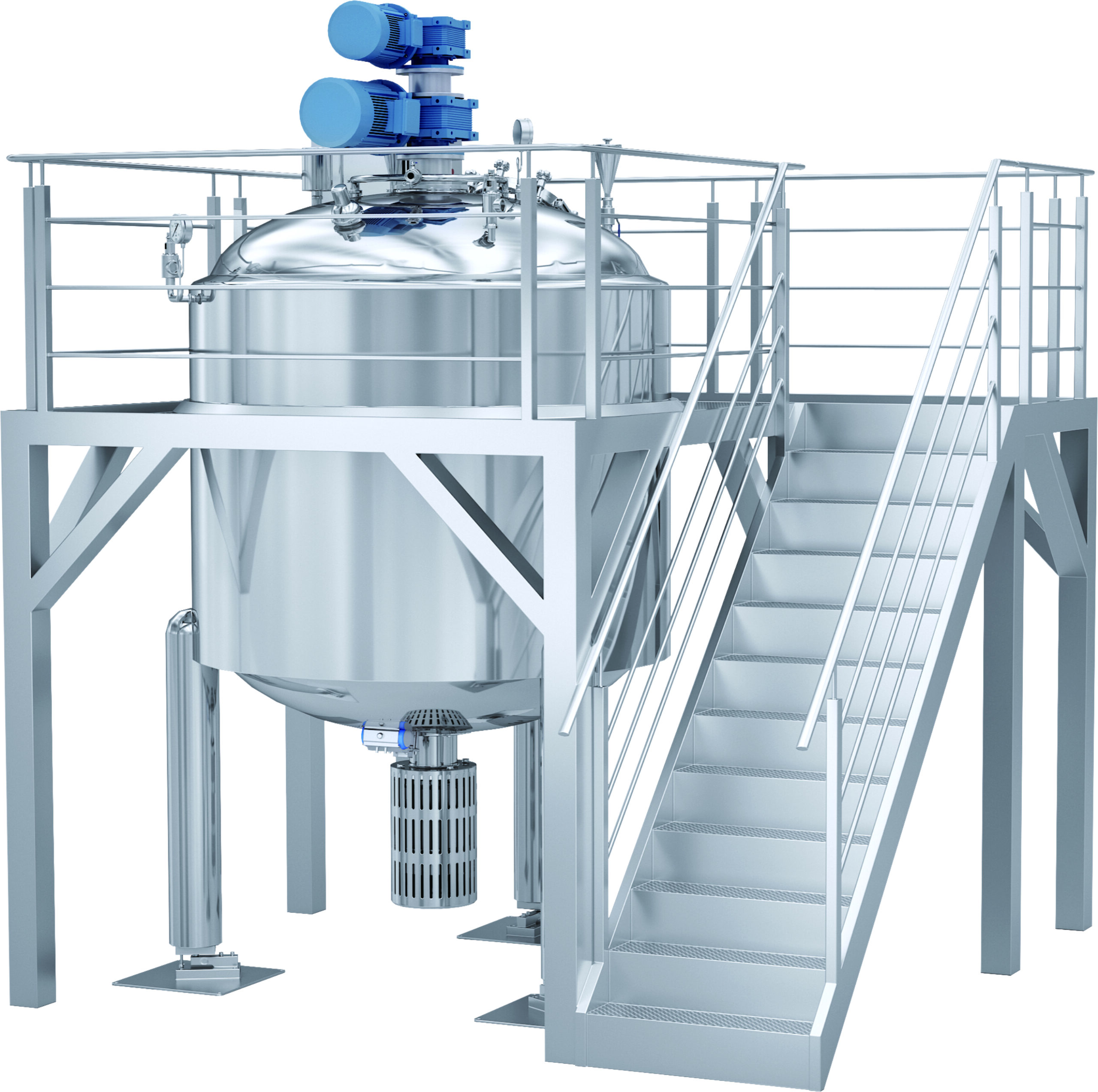
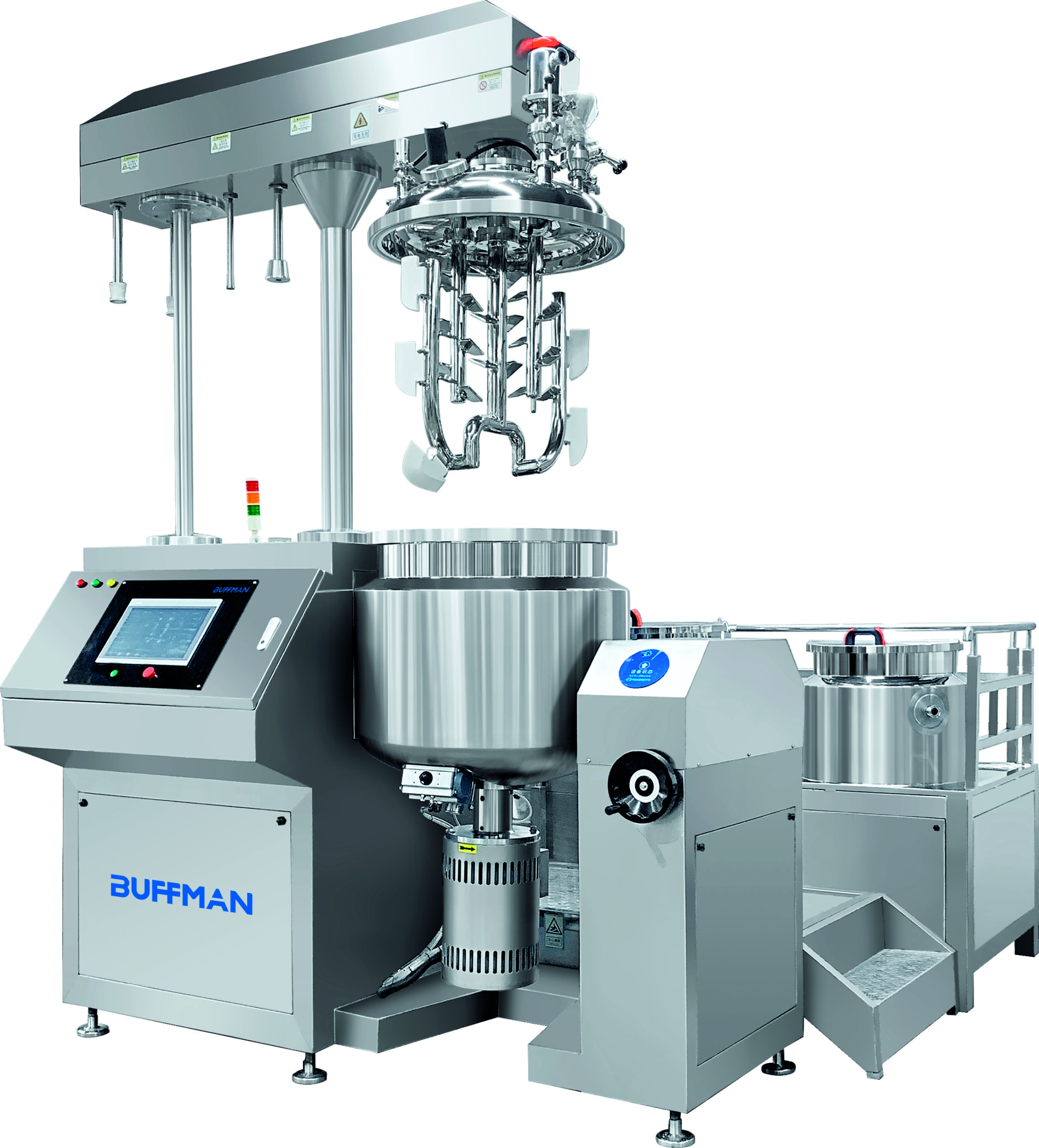
A vacuum homogenizing emulsifier is a jacketed tank with a bottom-mounted rotor-stator homogenizer and a slow wall-scraping agitator, operated under vacuum down to −0.09 MPa. Choose capacity from your batch size, homogenizer power from product viscosity, and lifting type from how often you change formulas. Buffman builds three series covering 5 L to 2,000 L.
What a vacuum emulsifier actually does
Four functions run at the same time inside one vessel. Removing any one of them is what separates a real emulsifier from a mixing tank with a stirrer.
Vacuum deaeration
Pulling the vessel to −0.09 MPa lets entrained air escape before the emulsion sets. The finished cream fills without bubbles and holds its surface gloss in the jar.
High-shear homogenization
The rotor-stator head moves material through a narrow gap, subjecting it to hydraulic shear, centrifugal extrusion, impact and turbulence more than 100,000 times per minute.
Wall-scraping agitation
A slow anchor or scraper blade continuously renews the film on the heated wall. That keeps heat transfer even and stops over-thickened product from burning onto the jacket.
Jacket heating and cooling
The jacket runs steam, hot water or chilled water. Both a steam and an electric heating figure are published for every model, so utilities can be sized before the order.
Why bottom-mounted
A bottom homogenizer draws material in from the floor of the vessel and shears it outward. That removes the dead zone a top-mounted head leaves in high-viscosity batches.
What comes out
O/W and W/O emulsions, creams, lotions, gels, ointments, pastes and suspensions — the grades used in cosmetics, personal care, pharmaceutical and food production.
Three series, three different jobs
The series name tells you how the tank opens and how material moves. Everything else — jacket, vacuum, homogenizer geometry — is shared.
- Main tank bolted to a frame, permanently aligned
- 100 L to 2,000 L working capacity
- Homogenizer 4 kW to 18.5 kW
- Built for continuous, high-volume campaigns
- Simplest installation and lowest maintenance load
- Column raises cover, agitator and homogenizer clear of the vessel
- 5 L to 2,000 L working capacity
- Homogenizer 0.55 kW to 18.5 kW
- Whole vessel exposed for loading, scraping and cleaning
- Best fit for many small batches of different formulas
- Hydraulic lift plus internal and external circulation loops
- 5 L to 2,000 L working capacity
- Product leaves the vessel, passes the homogenizer, returns
- Prevents stratification in very large batches
- For high-viscosity pastes and high-solids products
How to read the model number. The digits are working capacity in litres: BFM-G500 is 500 L, BFM-X2000 is 2,000 L. The letter is the frame type — G fixed, X hydraulic lift, W circulation. Homogenizer size scales with tank volume on every series.
How to choose, in five steps
Work through these in order. Each step eliminates models, so by the fifth you are usually down to one or two.
- Fix the batch size, not the tank size. Working capacity is the usable volume, not the vessel volume. A 500 L model runs a 500 L batch; leaving headspace for foaming and mixing means you buy the model above your target batch.
- Check the viscosity band. Low-viscosity lotions transfer easily and any series works. Pastes and high-solids products need the circulation loops of the BFM-W, because a single agitator cannot turn the whole batch over.
- Decide fixed or lifting. One formula running for weeks — fixed is cheaper and stays aligned. Several formulas a week with washdown between them — the lifting column pays for itself in cleaning time.
- Pick the heating medium. Steam heating on the BFM-G2000 needs 48.5 kW; electric heating of the same model needs 204.5 kW. If you have no steam boiler, size the electrical supply against that second number before anything else.
- Confirm vacuum and utilities. Ultimate vacuum runs from −0.09 MPa on the small models to −0.08 MPa on the 1,000 L and 2,000 L units. The vacuum pump adds 1.5 kW to 7.5 kW on top of the homogenizer and stirrer motors.
Do not size the homogenizer by tank volume alone. A 2,000 L vessel running a thin lotion does not need the 18.5 kW head that a 2,000 L pigment paste does. Send the viscosity and solids content with your enquiry — the homogenizer, not the tank, is what usually gets over- or under-specified.
BFM-G series specifications
Full published table for the fixed series. The BFM-X and BFM-W tables follow the same column structure and are listed on their own product pages.
| Model | Capacity | Homogenizer | Homogenizer speed | Stirrer | Stirrer speed | Vacuum pump | Steam heating | Electric heating | Ultimate vacuum |
|---|---|---|---|---|---|---|---|---|---|
| BFM-G100 | 100 L | 4 kW | 0–2,880 / 5,200 r/min | 1.5 kW | 0–63 r/min | 1.5 kW | 10 kW | 64 kW | −0.09 MPa |
| BFM-G200 | 200 L | 5.5 kW | 0–2,880 / 4,500 r/min | 2.2 kW | 0–63 r/min | 2.2 kW | 14.75 kW | 76.75 kW | −0.09 MPa |
| BFM-G300 | 300 L | 7.5 kW | 0–2,880 / 4,500 r/min | 3 kW | 0–63 r/min | 3 kW | 19 kW | 97 kW | −0.085 MPa |
| BFM-G500 | 500 L | 11 kW | 0–2,880 / 4,500 r/min | 4 kW | 0–63 r/min | 4 kW | 26.7 kW | 110.7 kW | −0.08 MPa |
| BFM-G1000 | 1,000 L | 15 kW | 0–2,880 / 4,500 r/min | 5.5 kW | 0–63 r/min | 5.5 kW | 38.5 kW | 146.5 kW | −0.08 MPa |
| BFM-G2000 | 2,000 L | 18.5 kW | 0–2,880 / 4,500 r/min | 7.5 kW | 0–63 r/min | 7.5 kW | 48.5 kW | 204.5 kW | −0.08 MPa |
Dimensions, jacket pressure and control options are not listed here. Parameters not shown in the table are confirmed per project before the order is released.
Where it is built
Buffman Technology (Jiangsu) Co., Ltd. has manufactured daily chemical and biopharmaceutical process equipment in Gaoyou, Jiangsu since 2007, on an 18,000 m² site with 13,000 m² of buildings.
The company holds more than 20 national patents. New products are built to GMP practice, and the works operate under EU CE certification and an ISO9001 quality management system. Buffman is a five-star member of the China Chemical Machinery Association.
Components come from Grundfos, ABB, OMRON, Schneider Electric, Siemens, SICK, DOW and other suppliers shown on the works’ component map. Final assembly, wiring and pressure testing happen on site under 6S management.
Frequently asked questions
What is the difference between a vacuum emulsifier and a mixing tank?
A mixing tank blends with an agitator. A vacuum emulsifier adds three things a tank does not have: a rotor-stator homogenizer that breaks droplets down to a controlled size, a sealed vessel held at negative pressure so air cannot be whipped in, and a wall-scraping agitator that keeps heat transfer even. Those three are what make an emulsion stable rather than merely mixed.
How do I know which capacity to order?
Start from your largest single batch and add headspace. Working capacity is the usable volume — a 500 L model runs a 500 L batch. If your target batch sits between two models, take the larger one; running a vessel full to the brim removes the freeboard the vacuum and foam control depend on.
What vacuum level should I expect?
The BFM-G and BFM-X series reach −0.09 MPa on the 100 L to 300 L models and −0.08 MPa on the 500 L to 2,000 L models. Larger vessels have more headspace and more surface to seal, so the attainable vacuum drops slightly as capacity rises. The toothpaste machine reaches −0.097 MPa because paste deaeration needs a deeper vacuum.
Can one machine handle both cream and toothpaste?
Not well in practice. Toothpaste is a high-solids paste that needs a wall-scraping agitator plus a separate high-speed disperser, and it runs at a deeper vacuum. A cream emulsifier’s agitator and homogenizer are sized for lower-viscosity emulsions. Plants making both usually run a BFM-G or BFM-X for creams and a dedicated BFM-YG for paste.
What information do you need to quote a machine?
Batch size in litres, product viscosity, solids content, required output per shift, heating medium available (steam pressure or electrical supply), vessel material, and the destination market’s certification requirement. Send those and the homogenizer and heating power can be fixed against the published tables rather than guessed.
Send your batch details, get a sized machine
Tell us these five things and we will come back with a model, a homogenizer size and a heating power against the published tables:
- Batch size per run (litres) and runs per shift
- Product type, viscosity band and solids content
- Heating medium available: steam pressure or electrical supply
- Required vessel material and surface finish
- Destination country and the certification the buyer needs
Sources and further reading
- Buffman Catalogue, Company Profile p.03 and Production Workshop p.06 — company facts, site area, patents, certifications.
- Buffman Catalogue, Vacuum homogenizing emulsifier (fixed type, bottom homogenizing) p.36–37 — BFM-G series technical parameters.
- Buffman Catalogue, Vacuum homogenizing emulsifier (hydraulic lift) p.34–35 and (internal and external circulation) p.38–39 — BFM-X and BFM-W parameters.
- Buffman Catalogue, Definition of Vacuum Emulsifier p.32 — shear mechanism and vacuum principle.
Related pages on this site:
BFM-G fixed emulsifier ·
BFM-X hydraulic lifting emulsifier ·
BFM-W circulation emulsifier ·
All emulsification equipment ·
Cosmetic manufacturing solutions ·
Toothpaste process and equipment ·
Tube filling: aluminium vs plastic ·
Vacuum emulsifier manufacturers directory ·
Fixed, lifting or circulation: which series ·
Supplying a line into Vietnam ·
Supplying a line into Indonesia ·
Supplying a line into India ·
Supplying a line into Nigeria ·
Supplying a line into Mexico ·
What drives the cost ·
Bottom or top entry homogenizer ·
Particle size and emulsion stability