
What Actually Drives the Cost of a Vacuum Emulsifier
Two suppliers can quote the same 1,000 L machine and the numbers can be far apart without either of them being dishonest. The reason is that a large part of what you will spend is decided before the machine: by how it is heated, what your building can supply, and where each quotation draws its boundary. This page sets out the six cost drivers, and shows the one — heating method — that can quadruple the electrical load of the same vessel.
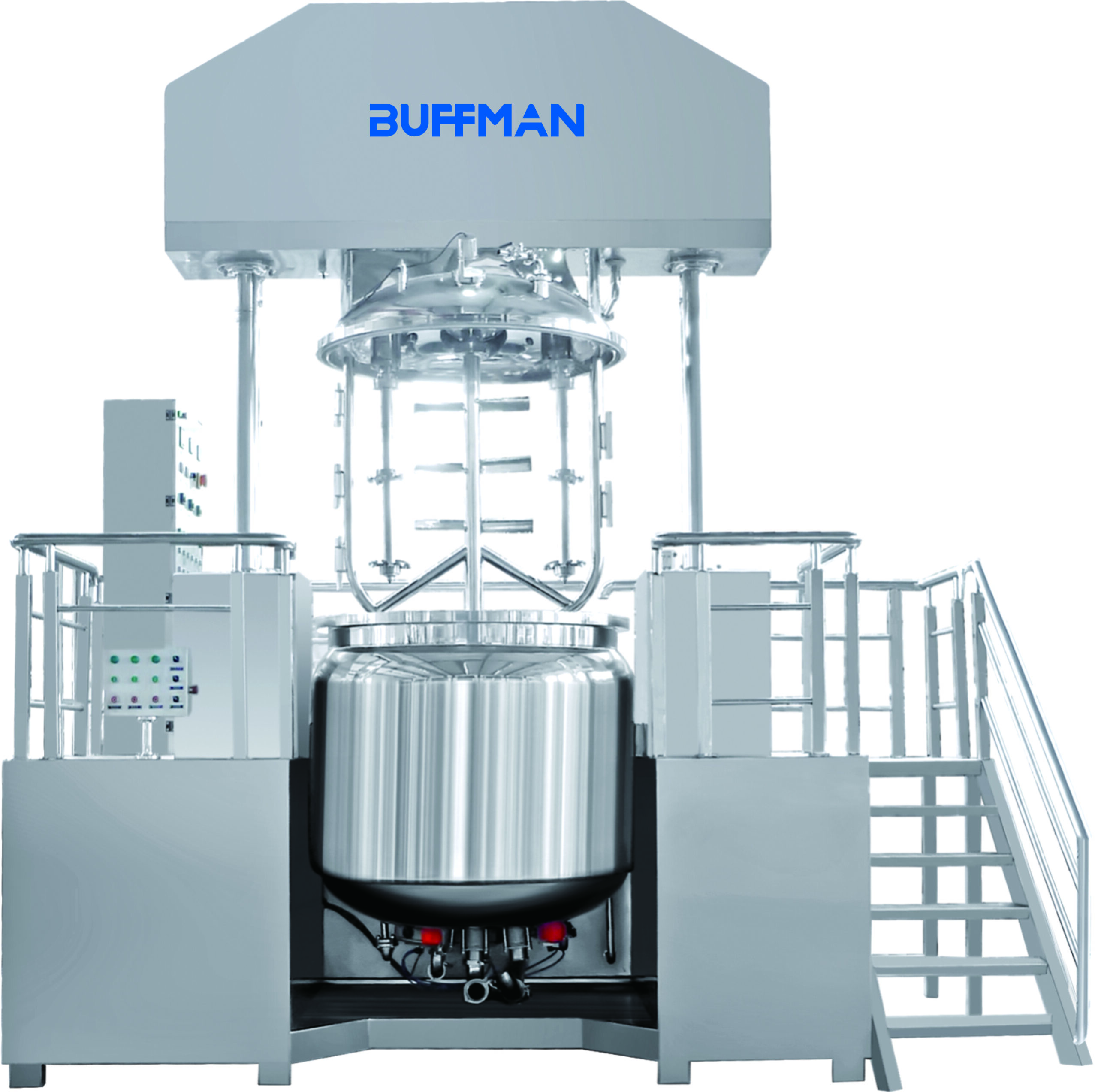
Six things set the cost of a vacuum emulsifier: the vessel and its wetted parts, the homogeniser and agitator drive train, the heating method, the vacuum system, the control system, and the documentation package. The heating method deserves attention first, because it is the only one that changes a cost outside the machine: on a 1,000 L unit, all-electric heating draws 146.5 kW against 38.5 kW for steam on the same vessel, and including the mechanical load that is 203 kVA against 76 kVA. The vessel is identical. The electrical installation behind it is not, and that installation is rarely on the quote sheet. The other five drivers are priced on the machine and can be compared line by line. We do not publish prices on this page, because a price without a scope boundary is not a number you can compare — the section on quote boundaries is the part worth reading first.
Four cost centres account for most of the difference between offers
Capacity is the obvious variable and the least informative one. At a fixed capacity, these four decide most of what you will spend.
Vessel and wetted parts
Working volume sets the shell size, and shell cost scales with surface area rather than volume. Grade and thickness of the wetted parts, internal finish, jacket design and whether the head opens determine both the price and whether the machine can be cleaned to a documented standard.
Homogeniser and agitator
Motor rating, tip speed at the rotor-stator gap, single or double mechanical seal, and whether the head is bottom-entry or top-mounted. A double seal with a barrier system is a different cost class from a single seal, and it is chosen by the solvent and the cleaning regime, not by preference.
Heating method
Electric in-tank, steam through a jacket, or hot oil. This is the largest single swing on the page: at 1,000 L, electric heating needs 3.8 times the heating load of steam and 2.7 times the total connected load. It changes the machine, the building supply and the running cost at once.
Control system
Pushbutton panel, PLC with HMI, or recipe management with batch records and data logging. The level chosen decides how much of each batch is documented automatically and how much is written down by an operator — which on an audited site is a labour cost as well as a hardware cost.
The two remaining drivers are the vacuum system and the documentation package. They are smaller in absolute terms than the four above, but they are where a quotation most often goes quiet: a pump rated for a deeper ultimate vacuum costs more and draws more power, and a full validation package — material certificates, a factory acceptance test with a signed record, IQ/OQ protocols, drawings in the customer’s language — is priced separately by some suppliers and bundled by others. Neither is usually the difference between two offers. The heating decision usually is.
| Driver | What moves it | On the quote sheet | Bearing on total spend |
|---|---|---|---|
| Vessel and wetted parts | Capacity, stainless grade, wall thickness, internal polish, jacket type | Visible as a capacity line | Large |
| Homogeniser and agitator | Motor kW, tip speed, seal type, head position | Visible as a model number | Large |
| Heating method | Electric, steam or hot oil | Visible as a word; the cost is not | Very large — see next section |
| Vacuum system | Pump type, ultimate vacuum, condenser | Visible | Medium |
| Control system | Pushbutton, PLC, recipes, data logging | Visible if itemised | Medium to large |
| Documentation and validation | Material certs, FAT, IQ/OQ, drawings, language | Often invisible | Medium |
The heating method is the largest line item that is not on the quote
Electric in-tank heating is the default in small machines because it needs no boiler and no steam line. Up to a few hundred litres it is also the cheaper way to build a machine, and the electrical question does not arise: a 100 L unit draws 71 kW in total, which any workshop supply will carry.
The ratio between the two methods is not the thing that changes with size — it stays between 3.8 and 6.4 times across the range. What changes is the absolute number. At 100 L the extra electrical demand is a workshop-scale load. At 1,000 L it is 203 kVA, and at 2,000 L it is 280 kVA. That is no longer a machine choosing its heating method; it is a heating method choosing the building.
The figures below are from our fixed-type vacuum homogenising emulsifier range, which is catalogued from 100 L to 2,000 L in six working capacities. Four are shown here — the two ends and the two most commonly ordered. For each, the table gives the mechanical load (homogeniser, agitator and vacuum pump added together) and then the heating load for both methods.
| Working capacity | Mechanical kW | Electric heating kW | Steam heating kW | Total, electric kW | Total, steam kW | kVA electric | kVA steam |
|---|---|---|---|---|---|---|---|
| 100 L | 7.0 | 64.0 | 10.0 | 71.0 | 17.0 | 84 | 20 |
| 500 L | 19.0 | 110.7 | 26.7 | 129.7 | 45.7 | 153 | 54 |
| 1,000 L | 26.0 | 146.5 | 38.5 | 172.5 | 64.5 | 203 | 76 |
| 2,000 L | 33.5 | 204.5 | 48.5 | 238.0 | 82.0 | 280 | 96 |
Read the 1,000 L row twice. The heating element alone is 146.5 kW against 38.5 kW — a factor of 3.8. Add the mechanical load and the connected demand becomes 203 kVA against 76 kVA, a factor of 2.7. The 100 L row is even more extreme, at 6.4 times the heating load, which is why small electric machines are unremarkable and large ones are not.
That 203 kVA is the number your building has to survive. A 1,000 L electric-heated emulsifier does not sit alongside a workshop’s existing supply; it determines it. A 250 kVA transformer, a dedicated feeder, switchgear rated for the fault level, and in most of the markets in this series a formal application to the utility for the connection. In Indonesia, India, Nigeria and Mexico those applications run on their own clock — months, not weeks — and they cost money that appears in no equipment quotation.
If you are comparing an electric-heated machine against a steam-heated one, compare the plant behind them, not the machines. One needs a 250 kVA connection and a generator to match it. The other needs a 100 kVA connection and a boiler — which has its own capital cost, its own fuel and its own operator, but which can also serve the rest of the factory. Ask both suppliers for the connected load schedule in kW and kVA, and take it to your electrical contractor before you compare prices. This single comparison changes the answer more often than the machine price does.

What one batch actually costs to heat, before you apply your own tariff
We are not going to quote an electricity price, because yours is not ours. What can be stated exactly is the energy the process needs, which is physics and does not change with the supplier. Multiply it by your own tariff and the running cost falls out.
Take a 1,000 L working capacity batch of a water-based emulsion: roughly 850 kg of product at 85% fill, heated from 25 °C to 85 °C.
| Step | Value | Note |
|---|---|---|
| Product mass | 850 kg | 85% fill of a 1,000 L working volume |
| Temperature rise | 60 K | 25 °C to 85 °C |
| Heat required | 213,180 kJ = 59.2 kWh | 850 × 4.18 × 60 |
| Electric in-tank, 98% efficient | 60.4 kWh | Electrical energy drawn at the element |
| Steam via boiler, 85% efficient | 69.7 kWh of fuel | Fuel energy, not electrical; measured at the boiler |
| Per tonne of product | 71.1 kWh/t | At 0.85 t per batch on the electric route |
At 250 batches a year that is roughly 15,100 kWh of electrical energy for heating, on top of the homogeniser, agitator, vacuum pump, jacket circulation and the chiller at the other end of the process. The same heat through a boiler is 17,400 kWh of fuel equivalent. Which of those two numbers is cheaper depends entirely on your local ratio between electricity and fuel, and that ratio varies enough between markets that no single answer is honest.
There is a second reason the energy figure matters. It is the honest way to check a heating claim. A supplier offering a larger electric element is not offering faster heating in proportion — the element is sized to overcome losses and hold temperature, not to halve the ramp. If the heating time quoted is materially shorter than this calculation supports, ask what the element rating is in kW and do the division.
A running-cost figure printed by a supplier is a number you cannot audit, built on a tariff you did not supply. The energy per batch is auditable: it depends on mass, specific heat and temperature rise, all of which you know. Take 60.4 kWh per 1,000 L batch, multiply by your industrial tariff and by your annual batch count, and you have a figure that survives your finance team. That is why this page has no prices on it.
Two quotes for the same capacity: what to compare before the number
Most of the gap between two quotations for a nominally identical machine is not a discount. It is a difference in where the boundary was drawn. The list below is the set of questions that resolves it, and they are worth asking in this order — the first seven change the machine, the last five change only the commercial terms around it.
| Item | What a thin quote often leaves open | What to ask for |
|---|---|---|
| 1. Wetted-part grade | “Stainless steel” | The grade and thickness of shell, head, jacket and all product-contact parts, in writing |
| 2. Internal finish | Not mentioned | Polishing standard and whether the head opens for inspection |
| 3. Heating method | “Electric” or “steam” | Element or jacket rating in kW, and the resulting connected load in kVA |
| 4. Seal type | Not mentioned | Single or double mechanical seal, and whether a barrier or flush system is included |
| 5. Vacuum system | Pump kW only | Pump type, ultimate vacuum in MPa, and whether a condenser is included |
| 6. Control level | “Control panel” | Pushbutton, PLC or recipe management; whether batch data is logged and exported |
| 7. Cleaning provisions | Not mentioned | CIP connections, spray ball, drain geometry, and whether the design is cleanable in place |
| 8. Factory testing | Assumed | Whether a FAT is performed, what it covers, and whether you may attend or receive the record |
| 9. Installation and commissioning | Excluded by default | Whether supervision is included, and for how many days |
| 10. Training | Not mentioned | Operator and maintenance training, on site or at the factory, and in what language |
| 11. Spare parts | Not included | The recommended first-year spares list, priced separately so you can see what it is |
| 12. Warranty route | “One year” | What is covered, who pays freight, and whether the response clock starts at the claim or at the diagnosis |
Items 1 to 7 are the ones that actually change the machine. A quotation that is silent on wetted-part grade, internal finish, seal type, connected load, vacuum level, control level and cleanability has not described a machine yet — it has named a capacity. The remaining five are commercial, and they are the ones that produce the surprise invoices after the machine lands.
Ask each supplier to state, in writing, the connected load in kVA and the wetted-part grade. Those two answers alone explain a large part of any price difference between offers, because they are the two items where a thin specification saves the most money and shows the least on paper. A supplier who cannot state them is not necessarily quoting badly; a supplier who will not state them has told you something useful.
Compare cost per tonne of product, not cost per machine
A machine price on its own cannot be judged. What can be judged is what each tonne of finished product carries in equipment cost, and that number behaves in a way most buyers do not expect.
A vessel’s cost is driven by its surface area, not its volume. Surface area scales with volume to the power of two-thirds. Double the working volume and the shell area rises by a factor of 1.59, not 2. So the machine gets more expensive sub-linearly while the output doubles.
| Working capacity | Tonnes per batch | t/year, 1 batch/day | t/year, 2 batches/day | Relative vessel area |
|---|---|---|---|---|
| 500 L | 0.42 | 106 | 212 | 1.00 |
| 1,000 L | 0.85 | 212 | 425 | 1.59 |
| 2,000 L | 1.70 | 425 | 850 | 2.52 |
Follow the logic: if the vessel is the dominant cost and it grows by 1.59 while output grows by 2.00, equipment cost per tonne falls by about 20% each time capacity doubles. That is the case for buying one size larger than the immediate need — with two conditions attached, and both matter.
The first condition is that the volume is real. A 2,000 L machine running one batch a week is not cheaper per tonne; it is a large vessel depreciating against almost no output. The saving only exists if the annual tonnage is there or is genuinely coming.
The second condition is that the scaling is not pure. Motor ratings, seal systems, control hardware and fabrication hours do not follow the two-thirds rule. They step in discrete increments and they do not get cheaper per unit as the vessel grows. In practice the 20% figure is the ceiling of the saving on the vessel, not the saving on the whole machine — and once heating load and building supply are included, a larger machine can cost more per tonne in total than a smaller one run on more shifts.
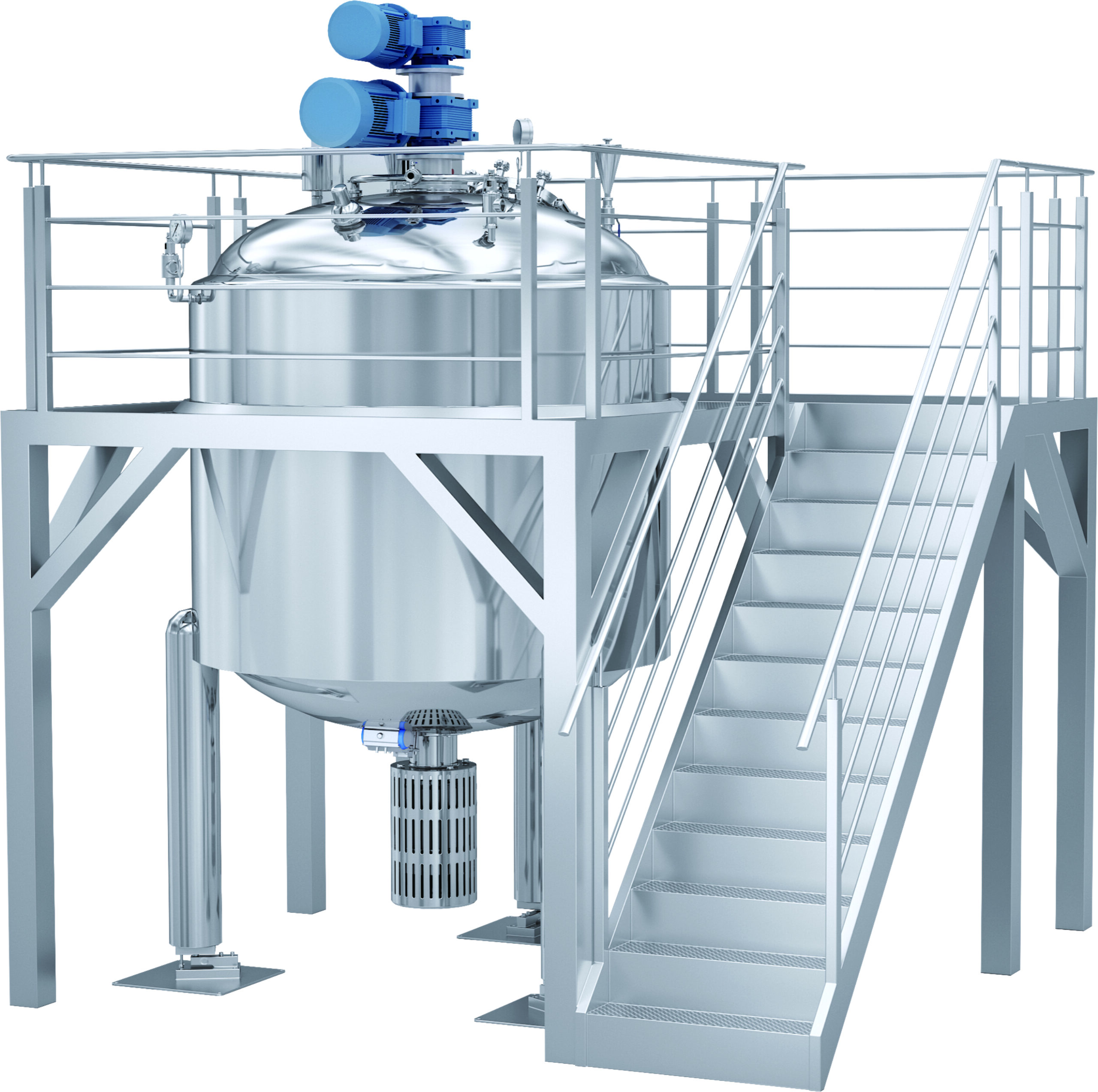
Before accepting a larger machine as the cheaper option per tonne, check what it does to your electrical supply. A 2,000 L electric-heated unit draws 280 kVA; the 1,000 L unit draws 203 kVA. If the larger machine forces a transformer upgrade that the smaller one does not, the per-tonne saving can be consumed entirely by the connection cost. Compare the two configurations including the building, not just the machines.
Sizing from your production plan, in one division
Most capacity questions are answerable before any supplier is contacted. Take the annual tonnage you need, divide by the number of batches you are willing to run in a year, and divide again by the fill ratio.
Required working volume (litres) = annual tonnes ÷ batches per year ÷ 0.85 × 1,000
| Annual output target | At 1 batch/day | At 2 batches/day | Nearest capacity |
|---|---|---|---|
| 50 t/year | 240 L | 120 L | Pilot or laboratory scale |
| 100 t/year | 470 L | 240 L | 500 L at one batch a day |
| 200 t/year | 940 L | 470 L | 1,000 L at one batch a day, or 500 L at two |
| 400 t/year | 1,880 L | 940 L | 2,000 L at one batch a day, or 1,000 L at two |
| 800 t/year | 3,760 L | 1,880 L | Two 2,000 L vessels, or 2,000 L at two batches |
The right-hand column is where the real decision sits, and it is not a machine decision. A 200 t/year requirement can be met by one 1,000 L vessel on a single daily shift or by a 500 L vessel on two shifts. The second option is a smaller machine, a smaller electrical supply and a smaller capital outlay — and it needs a second shift of operators, a second cleaning cycle and a tighter changeover. Whether that is cheaper depends on your labour cost and your cleaning regime, not on the equipment price.
This is also the point at which most projects discover they were sizing for the wrong number. A machine bought for the tonnage in the business plan, rather than the tonnage in the first two years, sits half-idle through the period when cash is tightest. Buying for year two and adding a second vessel in year three is frequently the better financial sequence, even though the second vessel costs more per litre than the first.
Annual tonnage and batches per day. With those two, the volume follows from the formula above and the conversation starts at the right capacity instead of working backwards from a machine someone already has in stock. Add the product’s approximate density and the heating method your building can support, and the quotation can be specific rather than indicative.
The questions that separate a specification from a price
None of the following is unusual or adversarial. All of them are answerable from a supplier’s own drawings, and a supplier who has built the machine can answer them without going away to check.
- What is the connected load in kVA, at the heating method you quoted?Not the motor kW — the total, with heating included. This is the number your electrical contractor needs and the number that decides whether your building can take the machine.
- What grade and thickness are the wetted parts?Shell, head, jacket and every product-contact component. “Stainless steel” is a material family, not a specification, and the difference between grades is a cost line as well as a corrosion question.
- Is the head fixed, or does it open?It decides whether the vessel interior can be inspected and cleaned to a documented standard. On a factory under any kind of audit this is a compliance feature rather than a convenience.
- What is the seal arrangement, and is a barrier system included?A single mechanical seal and a double seal with a barrier are different cost classes. The choice is set by the solvent load and the cleaning regime, and it should not be left to whichever is on the shelf.
- Which items in the quotation are excluded?Installation, commissioning, training, spares, freight, duties and the documentation package. Ask for a written exclusion list rather than assuming the inclusions cover them.
- What is the factory acceptance test, and will we see the record?A FAT that exists only as a word in a proposal is not a test. Ask what it covers, at what capacity, with what product, and who signs the record.
The first question is the one we would put first ourselves. Connected load is where the largest hidden cost lives, because it is the only number on the list that obliges you to spend money outside the equipment budget.

Questions we are asked about emulsifier cost
Why is there no price on this page?
Because a price without a scope boundary cannot be compared, and publishing one would push buyers into comparing numbers that describe different machines. The range within our own catalogue is wide enough that any single figure would be wrong for most readers: a 500 L electric-heated unit and a 2,000 L steam-heated unit differ in capacity, connected load, seal arrangement and documentation package. What this page can do honestly is set out what moves the price and how to compare two offers. Send the batch size and the product, and you will get a specific figure against a stated scope.
Is electric heating cheaper than steam?
For the machine, yes, up to a point — there is no boiler, no steam line and no burner management. For the installation, usually not, and the crossover comes earlier than most buyers expect. On a 1,000 L vessel, electric heating is 146.5 kW against 38.5 kW for steam, and the total connected load is 203 kVA against 76 kVA. If your building cannot supply 203 kVA without a transformer upgrade, the money saved on the boiler is spent on the connection. Which route is cheaper overall is a question about your building and your fuel price, and it cannot be answered from the machine specification alone.
Can we use a transformer to run a 380 V machine instead of ordering the right heating method?
Those are two different questions. A transformer handles voltage correctly — it is the standard way to match a machine to a supply. It does not handle connected load, which is what the heating method sets, and it does not reduce the current the machine draws. A 380 V electric-heated 1,000 L machine on a transformer still needs 203 kVA behind it; the transformer changes the voltage at the machine terminals, not the demand on the utility. If the constraint is your supply capacity rather than your voltage, the fix is the heating method, not a transformer.
How do we compare two quotes for the same capacity?
Reduce both to four comparable figures: connected load in kVA with heating included, wetted-part grade and thickness, seal arrangement, and the exclusions list. Two offers that match on those four are genuinely comparable and the price difference is a commercial one. Two offers that differ on any of them are not comparable at all, whatever the totals say. The twelve-item boundary table above is the full version of that comparison.
Does a larger machine always cost less per tonne?
Per tonne of vessel it does, because shell area grows more slowly than volume — doubling capacity raises the vessel’s surface area by about 59% while doubling output. Per tonne of installed system it often does not, because a larger machine can step you into a higher electrical supply tier, a larger chiller, and a longer cleaning cycle between batches. The saving is real but it is a saving on the vessel, and the vessel is not the whole system. Run the comparison with the building included before treating the larger machine as the cheaper one.
What information do you need to give a specific figure?
Annual tonnage or batch size, batches per day, the product type and its approximate density, the heating method your building can support, the wetted-part grade your cleaning regime requires, and the control level you need. With those six the quotation can be built against a stated scope rather than a capacity. If some are not yet decided, say so — the ones that are open are usually the ones worth discussing before the order, and they are cheaper to settle then.
Send the batch size and the product, and the quote will state its own scope
Tell us the annual tonnage, the batches per day, the product and the heating method your building can supply. The proposal will state the connected load in kVA, the wetted-part grade, the seal arrangement and the exclusions list, so you can put it beside another offer and compare the same things.