
Top 6 Mixing Machines for Cosmetic Manufacturing
Six machine types cover almost every mixing job in a cosmetic plant — but they are not interchangeable. A vacuum emulsifier, a jacketed reactor, a disperser and a paste mixer differ in shear, in vacuum capability and in what viscosity they can turn over. This page maps each type to the products it can and cannot make.
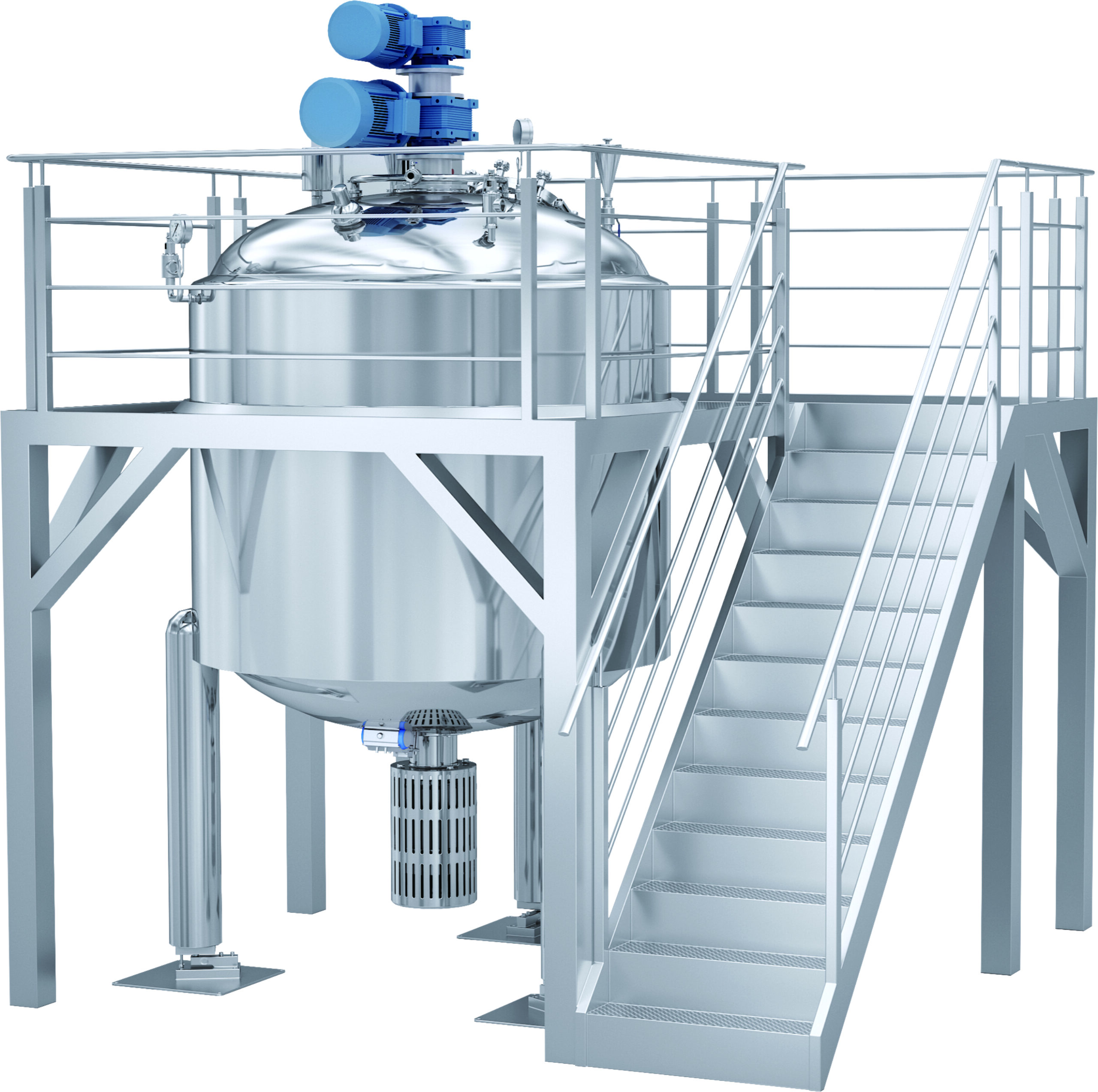
For emulsions such as creams, lotions and sunscreens, the machine is a vacuum homogenizing emulsifier — it is the only type on this list that combines a sealed vacuum vessel with a rotor-stator head. For aqueous surfactant products such as shampoo and body wash, a jacketed mixing reactor is sufficient. For toothpaste and other high-solids pastes, only a vacuum paste mixer will do. Dispersers, scraper tanks and inline homogenizers are supporting machines that improve a line rather than replace its main mixer.
Why the machine type decides your product, not the other way round
Cosmetic products are classified by their physical structure — emulsion, suspension, solution or paste. That structure is produced by the machine, so the machine has to be chosen before the formula is scaled. Buying a reactor and expecting emulsion-grade texture is the most common specification error in this industry.
Three questions narrow the list immediately. Is the product an emulsion or a solution? What is the viscosity at process temperature? Does the batch have to be deaerated? Answer those and usually one machine type remains.
The six machine types
Ordered by how often they are specified as the main mixer in a cosmetic plant.
Creams · lotions · sunscreens · gels
Vacuum homogenizing emulsifier
A jacketed vessel held under vacuum, fitted with a bottom-mounted rotor-stator homogenizer and a slow wall-scraping agitator. The vacuum prevents air from being whipped into the batch while the homogenizer forces the oil and water phases through a narrow shear gap, breaking droplets down to a controlled size. This is the only type on the list that performs deaeration and emulsification in the same vessel.
Buffman builds three variants: the BFM-G with a fixed main tank for continuous high-volume campaigns, the BFM-X with a hydraulic column that raises the cover and agitator clear of the vessel for cleaning between formulas, and the BFM-W which adds internal and external circulation loops for very high-viscosity batches.
Homogenizer 0.55–18.5 kW
Ultimate vacuum −0.08 to −0.09 MPa
Stirrer 0–63 r/min
Limit: a separate machine is still needed for any paste with high solids, and the vacuum pump adds load on top of the agitator and homogenizer motors.
Shampoo · body wash · detergent · gel
Liquid mixing and homogenizing reactor
A jacketed reactor with a choice of anchor, spiral or wall-scraping agitator, plus an optional built-in high-speed homogenizer. Its job is dissolving, blending and viscosity building in aqueous systems rather than emulsifying two immiscible phases. Most personal-care formulas are 60–80% water, so this is the highest-volume machine in a typical plant.
The jacket carries steam, hot water or chilled water, which allows heating for dissolution and cooling for heat-sensitive additives in the same unit. A PLC with touch screen holds temperature, agitator speed and homogenizing time so the viscosity repeats batch to batch.
Homogenizer optional built-in
Heating jacketed, steam or water
Control PLC + touch screen
Limit: without a homogenizer it cannot produce a stable emulsion. Without vacuum it cannot deaerate. Both omissions show up later as separation or surface bubbles.
Powder wetting · pigment dispersion · thickener incorporation
High-shear disperser
A vertical shaft carrying a toothed dispersion disc, lowered into an open vessel. The disc spins fast enough to create a strong shear and turbulence zone at its rim, pulling powder down into the liquid and wetting it out instead of letting it float. This is how thickeners, pigments and fillers are incorporated before the batch goes to the main mixer.
Buffman’s pneumatic version uses compressed air for the lift, which produces no spark and therefore suits explosion-proof or solvent-heavy areas. The column adjusts disc height for different container sizes and the disc can be exchanged without changing the drive.
Viscosity band low liquid to medium-high slurry
Disc quick release, exchangeable
Build explosion-proof capable
Limit: an open-vessel machine. It does not hold vacuum and does not produce a finished emulsion — it prepares material for one.
Cooling · holding · viscosity adjustment
Jacketed mixing tank with scraper agitator
A simpler vessel than the reactor: jacket for heating and cooling, slow agitator with wall-scraping blades, often used as a holding or buffer tank downstream of the emulsifier. The scraper continuously renews the film on the cooled wall, which keeps heat transfer efficient and stops over-thickened product from building up on the surface.
In a full line this machine typically appears three times: as an oil-phase tank, as a water-phase tank feeding the emulsifier, and as a finished-product buffer before the filling machine.
Agitator wall-scraping
Jacket heating and cooling
Duty continuous, low shear
Limit: low shear only. It cannot emulsify, disperse or deaerate on its own.
Toothpaste · high-solids paste · ointment base
Vacuum paste mixer
A heavy-duty vessel combining a slow wall-scraping agitator with a separate high-speed disperser, operated at a deeper vacuum than a cream emulsifier. Toothpaste is a highly aerated paste: pulling the batch to −0.097 MPa lets entrained air escape before filling, which raises density and surface gloss and stops tubes from looking hollow after crimping.
Splitting the duties matters. The agitator turns the bulk paste over slowly without overheating it, while the disperser breaks down abrasive and thickener agglomerates. Trying to do both with one shaft either burns the paste or leaves lumps.
Disperser 7.5–18.5 kW at 960 r/min
Stirrer 5.5–15 kW, 0–45 r/min
Ultimate vacuum −0.097 MPa
Total power 39–84.5 kW
Limit: over-specified for thin lotions, and the higher installed power means it is rarely the right first machine for a small plant.
Retrofit · final texture correction · high throughput
Inline homogenizer
A rotor-stator head mounted in a pipe rather than in a vessel. Product is pumped through it, sheared once, and returned to the tank or sent forward to filling. Because it processes a flow instead of a batch, it can be added to an existing line to improve texture without replacing the main mixer.
This is the typical upgrade path for a plant that already has reactors but cannot reach the droplet size its customers now ask for.
Duty single or multi-pass
Use retrofit, not replacement
Limit: adds no vacuum capability and no vessel. It is a texture tool, not a production unit.
The six types side by side
Only the emulsifier and the paste mixer are true main mixers with vacuum. The other four support them.
| Machine | Produces | Shear | Vacuum | Viscosity band | Role in line |
|---|---|---|---|---|---|
| Vacuum homogenizing emulsifier | Emulsion (O/W, W/O) | High | −0.08 to −0.09 MPa | Low to high | Main mixer |
| Mixing / homogenizing reactor | Solution, gel, surfactant blend | Low, optional high | None | Low to medium | Main mixer for aqueous |
| High-shear disperser | Wetted powder, dispersion | Very high | None | Low to medium-high | Pre-mix / support |
| Scraper mixing tank | Blend, hold, cool | Low | None | Low to medium | Phase or buffer tank |
| Vacuum paste mixer | High-solids paste | High + low | −0.097 MPa | Very high | Main mixer for paste |
| Inline homogenizer | Texture refinement | Very high | None | Low to medium | Retrofit / polish |
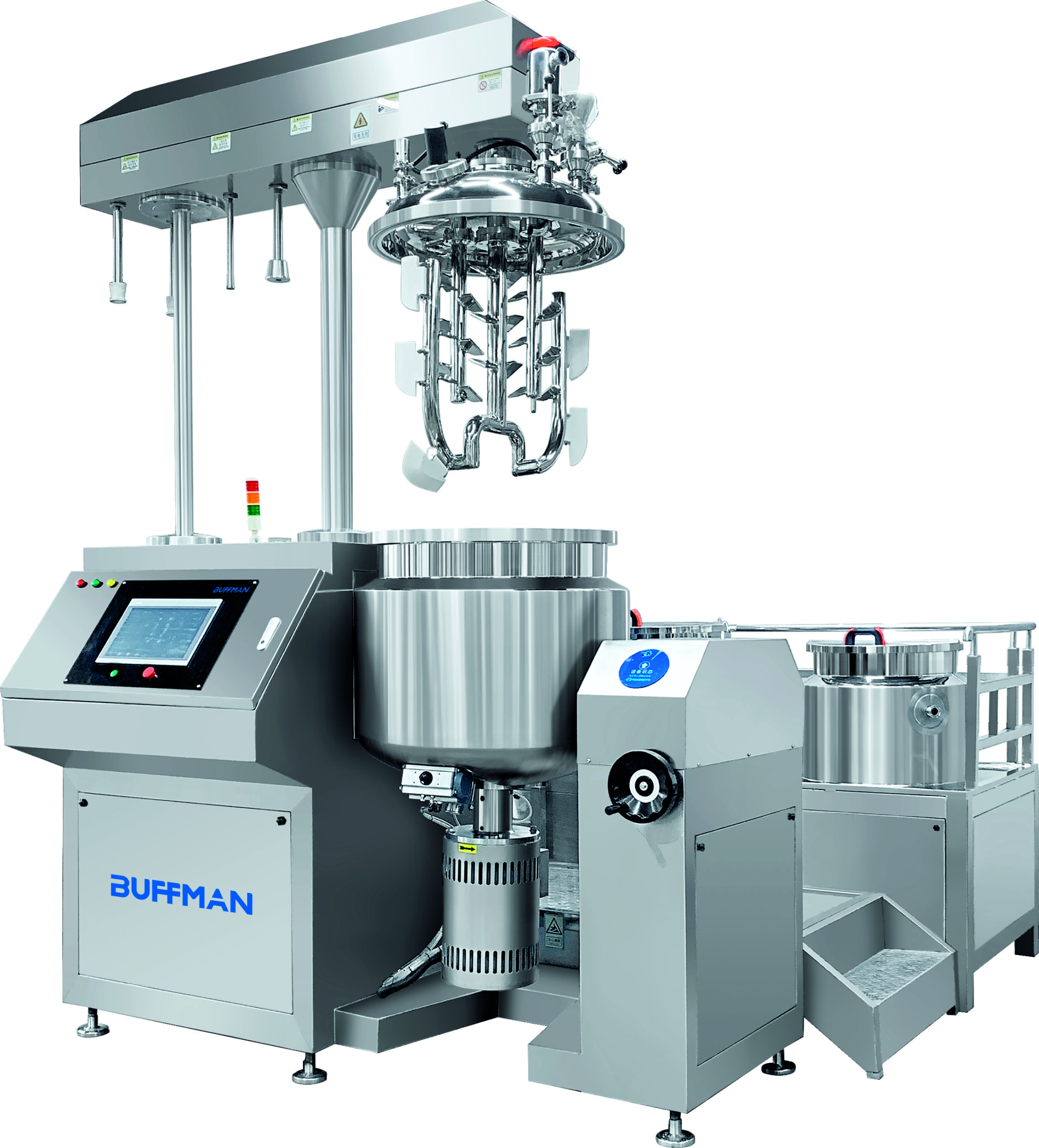
A complete cosmetic line uses five of the six
Oil phase and water phase are prepared in two scraper tanks, metered into the vacuum emulsifier for homogenization and deaeration, transferred to a buffer tank for cooling and viscosity adjustment, then pumped to filling. A disperser is added upstream only if the formula contains powders that are hard to wet out.
The paste mixer appears in a toothpaste or ointment plant in place of the emulsifier, with the tube filling machine downstream.
How to pick, in three steps
Taken in order, these three questions eliminate machine types rather than adding them.
- Is the product an emulsion or a solution? If it separates into two visible phases when left standing — cream, lotion, sunscreen, milk — it is an emulsion and needs a rotor-stator head plus vacuum. If it stays clear or uniformly translucent — shampoo, body wash, toner — a reactor will do.
- What is the viscosity at process temperature? Below roughly 10,000 cP any type works. Above that, an anchor or scraper agitator becomes necessary because a simple paddle cannot turn the batch over. Above roughly 100,000 cP, only a wall-scraping agitator combined with circulation or a separate disperser will process it uniformly.
- Does the batch have to be deaerated? If the product is filled into a transparent container or a squeeze tube, air bubbles are a visible defect and vacuum is mandatory. If it is filled into an opaque bottle, vacuum becomes a quality margin rather than a requirement.
The most expensive mistake is buying the tank before the process. Capacity is the easiest number to quote and the easiest to get wrong, because the machine that produces your texture may be one size smaller than the vessel that holds your batch. Send viscosity and solids content with the enquiry — those two values, not the litre figure, decide the homogenizer.
Frequently asked questions
Can one machine make both cream and shampoo?
Physically possible, economically poor. A shampoo batch needs dissolving and blending at high volume with low shear; a cream needs vacuum and a rotor-stator head. Running shampoo through an emulsifier wastes vacuum capacity and slows the line, while running cream through a plain reactor cannot produce a stable emulsion at all. Plants making both normally install a reactor for aqueous products and an emulsifier for emulsions.
Do I need a disperser if I already have an emulsifier?
Only if the formula contains powders that are slow to wet out, such as thickeners, pigments or fillers. The emulsifier’s homogenizer can wet them, but it does so slower and at the cost of aerating the batch. A separate disperser in an open vessel is the cheaper way to incorporate difficult powders before the batch reaches the vacuum vessel.
Is vacuum really necessary for a cream?
It is necessary if the product is filled into a clear jar, a tube or any transparent pack. Air entrained during mixing shows up as visible bubbles and a dull surface. Vacuum at −0.08 MPa or deeper removes it before the emulsion sets. For opaque packaging the requirement is softer, but density and gloss still differ measurably between a deaerated and a non-deaerated batch.
What capacity should a first-time buyer start with?
Start from the largest single batch you actually expect to run, then take the next model up. Working capacity is usable volume — a 500 L model runs a 500 L batch, with no freeboard for foam or for the vortex the agitator creates. Running a vessel full to the brim removes the headspace that vacuum and foam control depend on.
Which machine type suits a laboratory or pilot plant?
The same emulsifier geometry, at small scale. Buffman builds the BFM-X and BFM-W from 5 L upward so that homogenizer tip speed and temperature profile transfer to the 2,000 L production unit without redeveloping the formula. Buying a different machine type for the lab is what causes formulas that work at 5 L and fail at 500 L.
Tell us the product, we will name the machine
Send these five details and we will come back with a machine type, a model and the homogenizer size against the published tables:
- Product name and whether it is an emulsion, solution or paste
- Batch size per run and runs per shift
- Viscosity at process temperature and solids content
- Packaging type — clear jar, tube, opaque bottle
- Heating medium available and destination market certification
Sources
- Buffman Catalogue, Definition of Vacuum Emulsifier p.32 — shear mechanism and vacuum principle.
- Buffman Catalogue, Vacuum homogenizing emulsifier (fixed) p.36–37, (hydraulic lift) p.34–35, (internal and external circulation) p.38–39 — capacity, homogenizer power and ultimate vacuum figures.
- Buffman Catalogue, Vacuum toothpaste machine p.42–43 — disperser and stirrer power, ultimate vacuum, total installed power.
- Buffman Catalogue, Company Profile p.03 — founding year and manufacturing site.
Product pages referenced:
BFM-G fixed emulsifier ·
Fixed, lifting or circulation ·
What drives the cost ·
BFM-X hydraulic lifting ·
BFM-W circulation ·
Mixing reactor ·
Toothpaste machine ·
Pneumatic disperser