
Vacuum Emulsifier Supplier for Mexico: 60 Hz Is Not a Voltage Problem
Mexico is the only market in this series where the machine changes for a reason voltage cannot fix. The supply is 440 V at 60 Hz, so a four-pole motor turns 1,800 rpm instead of 1,500 — and a centrifugal pump’s shaft power rises with the cube of speed. A step-down transformer brings the voltage down and leaves the speed exactly where it was. Everything else follows from that: the control transformer taps, the NOM certificate that can only be held by a Mexican entity, and a duty line that PROSEC can move by 20 points.
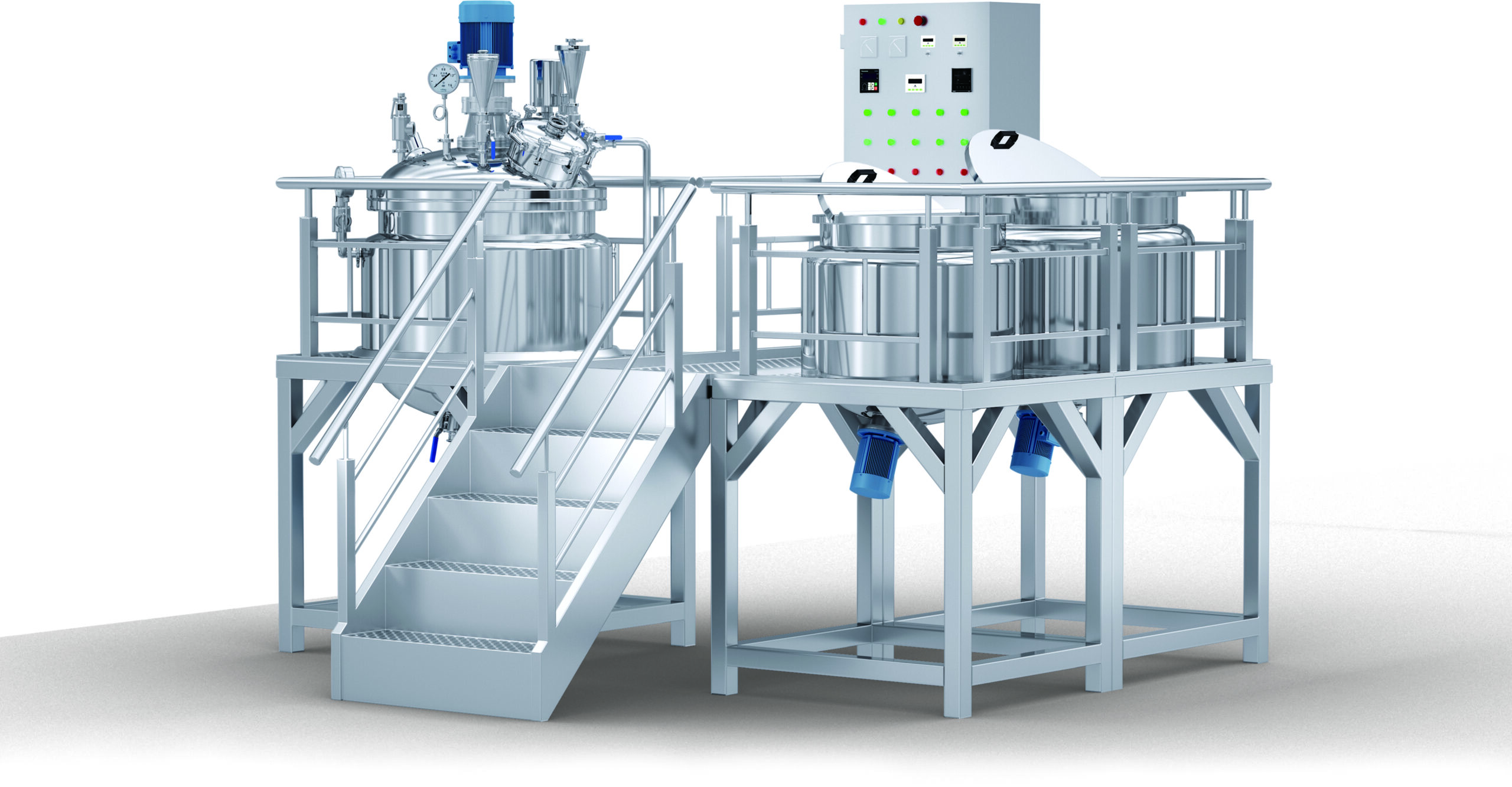
Specify 440 V, 60 Hz, and treat it as a re-rating rather than a re-tap. Mexico’s industrial distribution is 440 V three-phase at 60 Hz, with 480 V in some northern border plants and 127 V single-phase for control circuits. The 440 V is easy — the ratio to 380 V is 1.158, but volts-per-hertz actually falls slightly from 7.60 to 7.33, so the winding is not driven into saturation. The problem is the frequency: a four-pole motor goes from 1,500 to 1,800 rpm, a centrifugal pump’s shaft power rises about 73%, and the homogenising head’s tip speed rises 20%. A transformer fixes volts. Nothing but re-rating the drive train fixes hertz. On paperwork, NOM certificates can only be held by a Mexican legal entity, and the duty line is the one item PROSEC can move — from as much as 20% down to zero.
Four things that differ here — and the first one differs from every other market in this series
The frequency point is not a variation on the voltage point. It is a different failure mode with a different fix, and it is the one most often missed in a quote.
60 Hz re-rates the drive
1,500 to 1,800 rpm. Pump shaft power scales with the cube of speed. This is a drive-train decision, not a transformer decision.
254 V, not 220 V
Phase-to-neutral on a 440 V system is 254 V; on 480 V it is 277 V. A 220 V control circuit needs a tapped transformer, not a guess.
Your importer holds it
NOM certificates must be held by a Mexican legal entity. The manufacturer cannot apply. That changes who owns the compliance risk.
PROSEC moves 20 points
Chinese-origin machinery pays the general rate. A PROSEC-registered plant can bring the same line down to a fraction of it.
Why a transformer cannot fix a 60 Hz order
This is worth being precise about, because the two mistakes run in opposite directions and both are expensive.
The first mistake is treating Mexico as “380 V plus a transformer”. A 440-to-380 V step-down does bring the voltage into range. It does nothing to the frequency, and on a fixed-speed machine the frequency is what sets the shaft speed. A four-pole induction motor’s synchronous speed is 120 × frequency ÷ poles, so 50 Hz gives 1,500 rpm and 60 Hz gives 1,800 rpm — a flat 20% increase that no transformer touches.
The second mistake is the opposite: assuming 440 V on a 60 Hz grid is an overvoltage event like 415 V on a 50 Hz grid. It is not, and the arithmetic shows why. Insulation stress and core saturation track the volts-per-hertz ratio, not the voltage alone.
| Supply | Voltage | V/Hz ratio | 4-pole speed | What actually fails |
|---|---|---|---|---|
| China / Vietnam / Indonesia | 380 V / 50 Hz | 7.60 | 1,500 rpm | Reference case |
| India | 415 V / 50 Hz | 8.30 | 1,500 rpm | Insulation: 9.2% over-flux, slow ageing |
| Nigeria | 415 V / 50 Hz | 8.30 | 1,500 rpm | Insulation, plus a supply that swings 15–25% |
| Mexico | 440 V / 60 Hz | 7.33 | 1,800 rpm | Mechanical: speed, shear, pump power |
Read the Mexico row against the India row and the point becomes concrete. India is 9.2% over-flux with the speed unchanged — the motor ages faster but the process runs the same. Mexico is 3.5% under-flux with the speed up 20% — the magnetic circuit is fine and the process changes.
What +20% speed does to each part of the line
The affinity laws are the reason this matters more than it sounds. They are not rules of thumb; they are how a centrifugal machine behaves when you spin it faster.
| Element | Scaling | At +20% speed | Consequence on the line |
|---|---|---|---|
| Homogenising head tip speed | ∝ n | +20% | Higher shear rate. Droplet size falls and product temperature climbs faster than the recipe assumes. |
| Centrifugal transfer pump flow | ∝ n | +20% | Transfer times shorten. Operators notice this and assume the machine is simply “faster”. |
| Centrifugal pump head | ∝ n² | +44% | More pressure at the same valve setting. Line pressure and seal load both rise. |
| Centrifugal pump shaft power | ∝ n³ | +73% | The real hazard: a pump sized to the motor at 50 Hz is now drawing far past its rating. |
| Mechanical seal and bearing life | non-linear | shortened | Higher surface speed and heat. Wear parts that were annual become semi-annual. |
A main homogenising motor with a variable frequency drive is largely protected — the drive holds the commanded speed regardless of supply frequency. The transfer and circulation pumps are usually the fixed-speed items, and they are the ones that see 1,800 rpm instead of 1,500. A pump sized with a thin margin at 50 Hz will sit above its motor rating continuously at 60 Hz, and the symptom is not an immediate trip. It is a motor running hot in a Mexican summer, tripping on thermal overload at the worst hour of the afternoon, for a reason nobody connects to the grid.
What we change, and what stays the same
Being specific here is the difference between a real 60 Hz build and a label on a purchase order.
- Motor windings — wound for the order frequency, not re-tapped. A 50 Hz winding run at 60 Hz loses about 17% of its rated torque for the same frame, which matters on a positive-displacement load even if the pumps are fine.
- VFD parameters — the motor nameplate frequency and the V/f curve are set for 60 Hz, and the drive’s maximum output frequency is checked against the mechanical limit of the head, not the motor.
- Pump and motor pairing — re-checked at 1,800 rpm, not carried over from the 50 Hz bill of materials. Where the margin is thin, the pump is trimmed or the motor steps up.
- Control transformer taps — see the next section. This is where a 440 V order and a 480 V order diverge.
- Nameplate, drawings and manual — stated in the delivered configuration. A machine that arrives with a 50 Hz manual is a machine whose maintenance electrician will set the overloads wrong.

The control circuit is a separate decision, and it is the one people skip
Main power is straightforward once you accept the re-rating. The control circuit is where a correctly wound machine still fails on site, because the number everyone remembers is “220 V” and 220 V does not exist on a Mexican industrial supply.
Phase-to-neutral voltage is line voltage divided by the square root of three. On a 440 V system that is 254 V. On the 480 V systems found in some northern border plants it is 277 V. Feed a control circuit designed around 220 V with either of those and the contactor coils, relay coils, power-supply inputs and any 220 V indicator lamps run hot from day one — the same slow-failure pattern, in the cheapest components on the machine.
| Site supply | Phase-to-neutral | Control transformer primary tap | Note |
|---|---|---|---|
| 440 V, 3-phase, 60 Hz | 254 V | 440 V primary | Standard Mexican industrial supply |
| 480 V, 3-phase, 60 Hz | 277 V | 480 V primary | Common in northern border and maquiladora plants |
| 220 V, 3-phase, 60 Hz | 127 V | 220 V primary | Smaller loads; 127 V is also the domestic single-phase standard |
The practical answer is a multi-tap control transformer with 440 V and 480 V primaries so one build covers both. It costs very little at the factory and cannot be added economically on site. What it does not fix is a PLC or HMI power supply ordered as a 50 Hz part — those are frequency-specific and belong on the 60 Hz bill of materials, not in a note about transformers.
We can supply either configuration, but we cannot know which one your plant has. The two facts to send with the order are the site’s line voltage (440 or 480) and the frequency on the nameplate of an existing machine in the same building. A photo of an existing motor nameplate settles both questions faster than any discussion.
NOM: the certificate is held by your importer, not by us
Electrical products above 24 V entering Mexico are subject to mandatory NOM certification, and this is a structural difference from every other market in this series rather than a procedural detail.
A NOM certificate can only be held by a legal entity registered in Mexico. A Chinese manufacturer cannot apply in its own name. In practice the holder is the importer, the distributor, or the manufacturer’s Mexican subsidiary — and that entity carries the responsibility that comes with it. Testing is carried out in accredited Mexican laboratories, and the nameplate, manual and warning markings must be in Spanish, with the NOM mark and the importer’s details applied to the nameplate itself rather than on a sticker.
| Item | Position | Why it matters to the project |
|---|---|---|
| Certificate holder | Mexican legal entity only | Decide who this is before ordering. It shapes the invoice, the warranty route and who answers a customs query. |
| Electrical installation standard | NOM-001-SEDE-2012 | The 2012 edition is the one currently in force; a revision has been in process for some years. Confirm the edition your certification body is accepting at the time you file, not the edition quoted in an old proposal. |
| Certification bodies | ANCE, NYCE and others approved by the Ministry of Economy | Not a free choice — the body has to be accredited for the product family. |
| Typical duration | Roughly 8 to 16 weeks | Quoted by certification services in the market, not an official figure. It sits on the critical path if the plant is being commissioned to a date. |
| Certificate validity | About 1 year in the routine scheme; longer with factory surveillance | Plan the renewal into operations. A lapsed certificate is a shipment that does not clear. |
One is quoting a standard edition that is not the one in force. The other is treating NOM as a document the manufacturer supplies like a CE declaration. CE is self-declared by the manufacturer; NOM is certified by a Mexican body to a Mexican entity. If a supplier tells you they will “send the NOM certificate with the machine”, the question to ask is which Mexican entity’s name is on it.
This is also why the machine’s electrical documentation matters more in Mexico than elsewhere. The certification body reviews schematics and a bill of materials, and the importer — not us — is answerable for them afterwards. Complete, accurate drawings at order stage make that review a formality; incomplete ones turn it into a correspondence that runs for months.
Duty: the one line item that a program can move by 20 points
China and Mexico have no free trade agreement, so Chinese-origin machinery pays the general import duty. What has changed is that the general rate is no longer predictable from the tariff chapter alone: a decree published at the end of December 2025 raised duty on 1,463 tariff lines for countries without an agreement, with rates spanning roughly 5% to 50%, and industrial machinery lines were part of that review.
That makes the eight-digit classification the single most valuable piece of commercial work in the project. Chapter 84 is not a rate — it is a range that now runs from zero to a fifth of the customs value, and two similar machines can land on different lines depending on what the machine does.
| Duty route | Rate on CIF | Duty | DTA 0.8% | IVA 16% | Cash at border | True cost |
|---|---|---|---|---|---|---|
| PROSEC-registered plant | 0% | 0 | 480 | 9,677 | 10,157 | 480 |
| General rate, low band | 5% | 3,000 | 480 | 10,157 | 13,637 | 3,480 |
| General rate, mid band | 10% | 6,000 | 480 | 10,637 | 17,117 | 6,480 |
| General rate, upper band | 20% | 12,000 | 480 | 11,597 | 24,077 | 12,480 |
The figures are on a CIF value of USD 60,000, which is a mid-size line rather than a single vessel. The true-cost column is the one to budget against; the cash column is what your treasury has to fund for the weeks between clearance and the IVA recovery.
PROSEC and IMMEX are not the same thing, and they are frequently confused
Both appear in every guide to Mexican machinery import, and buyers routinely assume they are alternatives. They solve different problems.
| PROSEC | IMMEX | |
|---|---|---|
| What it addresses | The rate | The timing |
| Mechanism | A sector promotion program that applies a preferential duty to listed tariff lines for a registered manufacturer | A temporary import regime that defers duty and IVA on inputs processed and then exported |
| Effect on duty | Lower — reduced, potentially to zero | Deferred, not removed. If the goods stay in Mexico, the liability comes back. |
| Who can apply | The Mexican manufacturer, in its own sector | The Mexican importer or manufacturing entity |
| Our role | None — we cannot apply on your behalf | None — same |
Both programs are applied for by the Mexican party. A supplier cannot obtain either, and a supplier who offers to “arrange PROSEC” is describing something they cannot do. What we can do is supply the classification evidence — a technical description of what the machine does, photographs, and the nameplate data — that the importer’s broker needs to argue the eight-digit line. Send us the tariff line your broker proposes and we will confirm whether the machine description supports it.
One further distinction worth raising early: a machine imported permanently for sale or ownership transfer is a definitive import. A line brought in for installation and commissioning and then shipped back out can move under a temporary regime with a bond and no duty, provided the re-export deadline is met — miss it and the entry converts to a definitive import with the duty plus interest. If the project is a trial or a contract manufacturing arrangement, say so at quotation stage, because the customs route changes the price.
COFEPRIS: what actually has to be in place before a tube is sold
This is the section where the market’s published advice is least reliable, so it is worth separating what is settled from what is genuinely contested.
What is settled. The regulator is COFEPRIS, the Federal Commission for the Protection against Sanitary Risk. The entity that imports or sells has to file an Aviso de Funcionamiento — an operating notice for the premises — through the DIGIPRiS platform. Labels must comply with the Mexican labelling standard for cosmetics, in Spanish. Import documentation has to be complete at the border. Any claim that the product treats, prevents or diagnoses a disease moves it out of the cosmetic category and into a different, heavier regime entirely.
What is contested. Whether every ordinary cosmetic requires a per-product sanitary registration with a five-year validity. Sources in the market state this plainly. Others — including analyses that go back to the regulator’s own guidance — argue that ordinary cosmetics are not subject to per-product registration at all, and that the real obligations are the premises notice, formula and label compliance, and import documentation. There is no single public database where you can look up a “registration” for an ordinary cosmetic SKU.
The two positions lead to different budgets and different timelines, and the one that applies depends on how your product is classified and who is filing. What we will say is this: a quotation described as “COFEPRIS cosmetic registration” is not a scope of work — it is a phrase. Ask any consultancy quoting it to name the filing, the responsible entity, and the document you receive at the end. If those three cannot be named, the line item is a placeholder.
Where this touches the machine rather than the paperwork is the audit trail. A factory that has to demonstrate GMP compliance for cosmetics needs cleaning records, material traceability and a documented cleaning validation for contact surfaces. Those records are produced by the equipment, not by a consultant, and they are far cheaper to design in than to retrofit. If the Mexican entity is filing on the basis of a factory inspection, the equipment specification is part of the submission.
On materials: our filling and sealing machines are catalogued in 304 and 316L stainless steel. For an emulsifier on an aggressive cleaning regime we do not publish a fixed wetted-part grade as a catalogue number — send the cleaning agents your process uses and we will specify the grade in writing for that duty. Assuming a grade is how a machine ends up with a corrosion problem eighteen months into a five-year compliance cycle.
The order of operations, because three of these run in parallel and one does not
Mexico has more parallel tracks than the other markets in this series, and the failure mode is usually not a single step going wrong — it is two tracks that were assumed to be sequential being run in the wrong order.
- Confirm the site supply, in writingLine voltage (440 or 480), frequency, and a photo of an existing motor nameplate. This single step determines the winding, the control transformer taps and the VFD parameters. Everything downstream depends on it, and it is the cheapest thing on this list to get right.
- Settle the tariff classification before the POThe eight-digit line sets the duty, the NOM exposure and whether PROSEC applies. Your broker proposes it; we supply the technical description that supports it. A classification argued after the vessel sails is a classification argued under time pressure.
- Decide which Mexican entity holds the NOM certificateImporter, distributor or subsidiary. This is a commercial decision with a compliance consequence, and it has to be made before the machine is built because the nameplate carries the importer’s details.
- Start NOM in parallel with production, not after itEight to sixteen weeks is the market’s figure for certification. Production and certification can overlap; certification and shipment cannot be reordered if the certificate is late.
- Confirm the COFEPRIS position for the product, separatelyThis is the buyer’s filing, not the machine’s. Resolve the premises notice and the labelling question while the machine is in build, because that is the slack in the schedule.
- Check the re-export clock if the import is temporaryA temporary entry has a deadline. If the project is a trial or contract manufacturing, the date the entry converts to a definitive import is a real cost, not a formality.
Classification before purchase order. Everything else can overlap. A wrong eight-digit line discovered after the PO changes the duty, may change the NOM scope, and may invalidate a PROSEC claim — and by then the machine is being built to a price that is no longer correct.
Questions we are asked before a Mexican order
Can we just add a 440 V to 380 V transformer and run the standard machine?
For the voltage, yes — the winding sees roughly 380 V and the insulation is fine. For the frequency, no. A transformer does not change 60 Hz to 50 Hz, so a four-pole motor still turns 1,800 rpm instead of 1,500. On the main homogenising motor under VFD control that is manageable, because the drive sets the speed. On the fixed-speed transfer and circulation pumps it is not: shaft power rises with the cube of speed, so a pump sized with a thin margin at 50 Hz sits above its motor rating continuously. The symptom appears months later as a thermal trip on a hot afternoon, and it is rarely traced back to the grid.
Is a 60 Hz build more expensive than a 50 Hz build?
It depends on how much of the drive train has to change rather than be re-tapped. Winding motors for the order frequency and setting the VFD parameters is normal engineering at order stage. Stepping up a pump motor because the 1,800 rpm shaft power exceeds the 50 Hz selection is real cost, and it is exactly the cost that a quotation described only as “60 Hz version” tends to hide. Ask for the pump and motor schedule at 60 Hz, not just a line item.
Who applies for the NOM certificate?
The Mexican legal entity that will hold it — typically the importer, the distributor, or a Mexican subsidiary. A foreign manufacturer cannot be the certificate holder. Testing runs in accredited Mexican laboratories, documentation must be in Spanish, and the mark and importer details go on the nameplate itself. Practically, this means the certificate is not something we hand over with the machine; it is something your Mexican entity obtains, with our technical documentation as input.
Which NOM edition applies to the electrical installation?
NOM-001-SEDE-2012 is the edition currently in force, and a revision has been in process for several years without displacing it. That matters because some commercial proposals still cite other editions. Before you budget, confirm with the certification body you intend to use which edition it is accepting at the time you file — the answer can change between quotation and submission, and an old proposal is not evidence of the current position.
How much duty will we pay on a Chinese-origin emulsifier line?
It cannot be answered from the tariff chapter. A decree published at the end of December 2025 raised duty on 1,463 lines for countries without a trade agreement, so chapter 84 is now a range rather than a rate. The number that applies comes from the eight-digit classification your broker proposes, and we supply the technical description to support it. If your plant is registered under a sector promotion program, the same line can attract a materially lower rate — but that application is yours, not ours, and it must be in place before the entry.
Does our cosmetic product need a COFEPRIS registration before we can sell?
The settled part is that the importing or selling entity files an operating notice for its premises, labels comply with the Mexican cosmetics labelling standard in Spanish, and import documentation is complete. Whether an ordinary cosmetic additionally needs a per-product sanitary registration is genuinely contested in the published guidance, and the answer depends on how your product is classified and who is filing. We do not resolve that for you, and we would be sceptical of anyone who resolves it in a single sentence. What we can say is that the factory’s cleaning and traceability records are part of the evidence base either way, and those come from the equipment.
Send the site voltage and the product, and we will quote the actual configuration
A 440 V, 60 Hz quotation and a 380 V, 50 Hz quotation are not the same machine with a different price line. Tell us the site line voltage, the frequency on an existing motor nameplate, the batch size and the cleaning regime, and the proposal will state which parts are re-rated, which are re-wound and which are unchanged.