
Vacuum Emulsifier Series: Fixed, Lifting or Circulation
Buffman builds three vacuum emulsifier series and they overlap almost completely on paper — same vacuum, same stirrer speed, same motor ratings at matched capacity. So the choice is not about which one performs better. It is about three mechanical questions: how small the batch goes, whether the head needs to lift, and whether the product needs circulation.
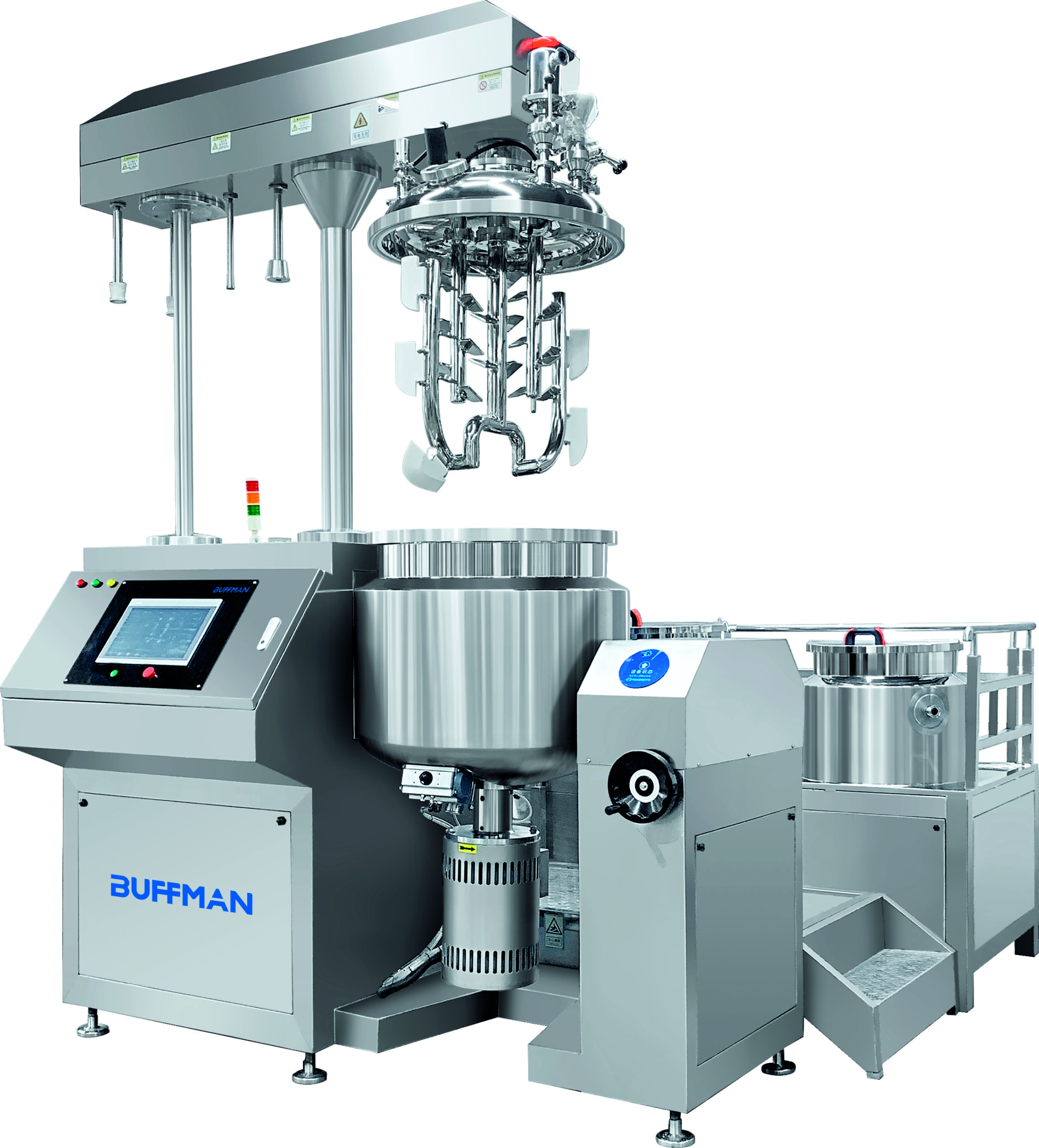
If your smallest batch is under 100 L, the fixed series is not available to you — choose between hydraulic lifting (BFM-X) and hydraulic lifting with circulation (BFM-W), both from 5 L. If your smallest batch is 100 L or more, decide by changeover frequency: a plant running one formula for weeks should take the fixed series (BFM-G), because it is structurally simpler and cheaper to install; a plant changing formula several times a week should take lifting, because the head comes off without dismantling anything. Circulation (BFM-W) is for products that stratify in the vessel or that need the whole batch passed through the homogenizer repeatedly rather than only the volume near the bottom head.
The three series
Same tank, same homogenizer principle, same vacuum system. The difference is the mechanical arrangement around them.
Fixed
- Main tank fixed to the frame
- Bottom-entry rotor-stator homogenizer
- Stirrer 0–63 r/min, wall-scraping
- Built for continuous production runs
Choose when: one formula runs for long stretches and the tank does not need to open often.
BFM-X
Hydraulic lifting
- Tank lifts vertically on a hydraulic column
- Bottom-entry rotor-stator homogenizer
- Head lifts clear for loading and cleaning
- Same power ratings as the fixed series at matched capacity
Choose when: formula changes are frequent, or the batch is small enough that cleaning time dominates.
Lifting + circulation
- Everything the lifting series has
- Adds internal and external circulation paths
- Whole batch passes the homogenizer repeatedly
- Higher homogenizer power at 5 L (0.75 vs 0.55 kW)
Choose when: the product stratifies, or homogenization must reach the full batch rather than the zone near the head.
What is identical across all three
This matters because it removes most of the usual sales arguments. At the same working capacity, the numbers that decide performance do not change.
| Parameter | BFM-G | BFM-X | BFM-W |
|---|---|---|---|
| Stirrer speed | 0–63 r/min | 0–63 r/min | 0–63 r/min |
| Ultimate vacuum, 5–300 L | −0.09 MPa | −0.09 MPa | −0.09 MPa |
| Ultimate vacuum, 500 L | −0.085 MPa | −0.085 MPa | −0.085 MPa |
| Ultimate vacuum, 1,000–2,000 L | −0.08 MPa | −0.08 MPa | −0.08 MPa |
| Homogenizer motor, 100 L | 4 kW | 4 kW | 4 kW |
| Homogenizer motor, 500 L | 11 kW | 11 kW | 11 kW |
| Homogenizer motor, 2,000 L | 18.5 kW | 18.5 kW | 18.5 kW |
| Stirrer motor, 500 L | 4 kW | 4 kW | 4 kW |
| Steam heating power, 500 L | 26.7 kW | 26.7 kW | 26.7 kW |
Why this matters when you compare quotations. If two suppliers quote the same capacity with the same homogenizer power and the same vacuum level, the machine will not perform differently because of the series name. The difference is in how it is built and how it is taken apart. Ask what the head-lifting mechanism is, and how long a changeover actually takes — not what the series is called.
The three differences that decide it
- How small the smallest batch isThe fixed series starts at 100 L. If your pilot or small-order batches are 5 L, 10 L or 50 L, the fixed series simply is not a candidate — the lifting series covers 5 L to 2,000 L as one continuous range. This is the first filter, and it eliminates a whole series before you look at anything else.
- Whether the head has to liftOn a fixed machine, opening the vessel means releasing clamps and, on larger sizes, working around a tank that does not move. On a lifting machine the tank descends, the head stays on the column, and the interior is open. For a plant cleaning the vessel twice a week this is convenience. For a plant cleaning it twice a shift on small batches, it is the difference between a two-hour changeover and a twenty-minute one.
- Whether the product stratifiesThe fixed and lifting series homogenize through a bottom head — effective for the material drawn into it, which is why the bottom-entry design matters for viscous product. The circulation series adds a path that takes material from elsewhere in the vessel and returns it through the homogenizer, so the whole batch sees the shear rather than only the volume near the bottom. Relevant for high-solids or high-viscosity formulas where the top layer would otherwise sit undisturbed.
Decision flow
Three questions, in this order. The first one can end the conversation.
-
1. What is your smallest production batch?Under 100 L → BFM-X or BFM-W only. The fixed series starts at 100 L.
100 L or more → all three are available, continue to question 2. -
2. How often does the vessel have to be opened?Rarely, with long production runs → BFM-G fixed. Fewer moving parts, simpler install, no hydraulic system to maintain.
Every shift, or several times a week → lifting series, because access is the whole point of the mechanism. -
3. Does the batch stratify, or must shear reach the whole volume?No — the bottom head is enough → BFM-X.
Yes, high solids or high viscosity where the top layer sits undisturbed → BFM-W circulation.
Parameters at matched capacity
Only the shared capacities are shown, so the comparison is honest. The lifting series also covers 5, 10 and 50 L, where the fixed series has no equivalent.
| Working capacity | Homogenizer motor (kW) | Stirrer motor (kW) | Vacuum pump (kW) | ||||||
|---|---|---|---|---|---|---|---|---|---|
| G | X | W | G | X | W | G | X | W | |
| 100 L | 4 | 4 | 4 | 1.5 | 1.5 | 1.5 | 1.5 | 1.5 | 1.5 |
| 200 L | 5.5 | 5.5 | 5.5 | 2.2 | 2.2 | 2.2 | 2.2 | 2.2 | 2.2 |
| 300 L | 7.5 | 7.5 | 7.5 | 3 | 3 | 3 | 3 | 3 | 3 |
| 500 L | 11 | 11 | 11 | 4 | 4 | 4 | 4 | 4 | 4 |
| 1,000 L | 15 | 15 | 15 | 5.5 | 5.5 | 5.5 | 5.5 | 5.5 | 5.5 |
| 2,000 L | 18.5 | 18.5 | 18.5 | 7.5 | 7.5 | 7.5 | 7.5 | 7.5 | 7.5 |
| 5 L | — | 0.55 | 0.75 | — | 0.25 | 0.25 | — | 0.25 | — |
| 10 L | — | 1.1 | 1.1 | — | 0.25 | 0.25 | — | 0.25 | — |
| 50 L | — | 3 | 3 | — | 0.75 | 0.75 | — | 1.5 | — |
Envelope dimensions, fixed series
| Model | Working capacity | L × W × H (mm) |
|---|---|---|
| BFM-G100 | 100 L | 680 × 680 × 1,800 |
| BFM-G2000 | 2,000 L | 1,880 × 1,880 × 3,350 |
Four mistakes in series selection
- Buying the lifting series for access you will not useIf the plant runs one formula for six weeks at a time, the hydraulic column is capital and maintenance you are paying for and never using. Fixed is the right answer for that plant, and it is also cheaper to install.
- Buying the fixed series when the batch is 50 LThe fixed series starts at 100 L. A plant quoting a 50 L pilot batch against a 100 L fixed machine is not buying a smaller machine, it is buying a machine that runs at half fill — and the wall scraper cannot reach the product at that level.
- Assuming circulation fixes a badly chosen homogenizerCirculation moves material to the head more times. It does not add shear capacity. If the homogenizer is undersized for the viscosity, circulating it longer does not make the droplet size smaller — it just takes longer to reach the same result.
- Comparing series names instead of numbersAt matched capacity the three series share the same motor ratings and the same vacuum levels. A quotation that is 20% more expensive for “the better series” at the same capacity needs a mechanical explanation, not a marketing one.
Frequently asked questions
Is the circulation series a better machine than the lifting series?
No. It does one additional thing — it passes the batch through the homogenizer repeatedly instead of only drawing from the bottom. Whether that matters depends entirely on whether your product stratifies. For a conventional emulsion, it does not add anything you can measure.
Why does the fixed series start at 100 L when the others start at 5 L?
Because below 100 L the value of a fixed frame disappears. Small batches are changed and cleaned far more often, so access becomes the dominant requirement rather than structural stability. The lifting arrangement is what makes a 5 L batch practical.
Can the fixed series be cleaned without opening the tank?
Cleaning-in-place is possible with a spray ball, and many plants do it. What you cannot do on a fixed machine is reach the interior for inspection or manual cleaning without releasing the head. If your quality system requires visual inspection between batches, that is a lifting case.
Do all three reach the same vacuum level?
Yes, at matched capacity. −0.09 MPa from 5 to 300 L, −0.085 MPa at 500 L, −0.08 MPa from 1,000 to 2,000 L. The drop at larger sizes is because a bigger vessel has more headspace to seal, not because the series differ.
Which series suits a laboratory or pilot plant?
The lifting series, from 5 L up. That is exactly why the 5 L and 10 L models exist in the X and W ranges — so a formula developed at 5 L transfers to a 2,000 L production machine with the same homogenizer geometry and the same vacuum level.
What information do you need to recommend a series?
Smallest and largest batch in litres, how often the formula changes, whether the product stratifies or holds suspension, viscosity or solids loading, and the ceiling height and door width at the installation point.
Tell us the batch range and the changeover
Two facts usually settle it: the smallest batch you will actually run, and how many times a week the vessel is opened. Send those and we will say which series, or say that the cheaper one is enough.
- Smallest and largest production batch in litres
- Formula changes per week
- Viscosity or solids loading
- Ceiling height and door width at the installation point
Sources and further reading
- Buffman Catalogue, Vacuum homogenizing emulsifier (hydraulic lift, bottom homogenizing) p.34–35 — BFM-X series parameters.
- Buffman Catalogue, Vacuum homogenizing emulsifier (fixed type, bottom homogenizing) p.36–37 — BFM-G series parameters and dimensions.
- Buffman Catalogue, Vacuum homogenizing emulsifier (internal and external circulation) p.38–39 — BFM-W series parameters.
- Buffman Catalogue, Definition of Vacuum Emulsifier p.32 — rotor-stator shear principle and the role of the bottom-entry homogenizer, referred to in the difference between series.
Related pages on this site:
BFM-G fixed series ·
BFM-X lifting series ·
BFM-W circulation series ·
Vacuum emulsifier selection guide ·
What drives the cost ·
All emulsification equipment