
Toothpaste Manufacturing Process and Equipment
Toothpaste is not an emulsion. It is a paste — roughly half abrasive powder held in a humectant gel, stiff enough to stay on a brush and smooth enough to pass a 25 mm tube opening. That single fact decides which machines a toothpaste line needs, and why an emulsifier cannot substitute for a vacuum paste mixer.
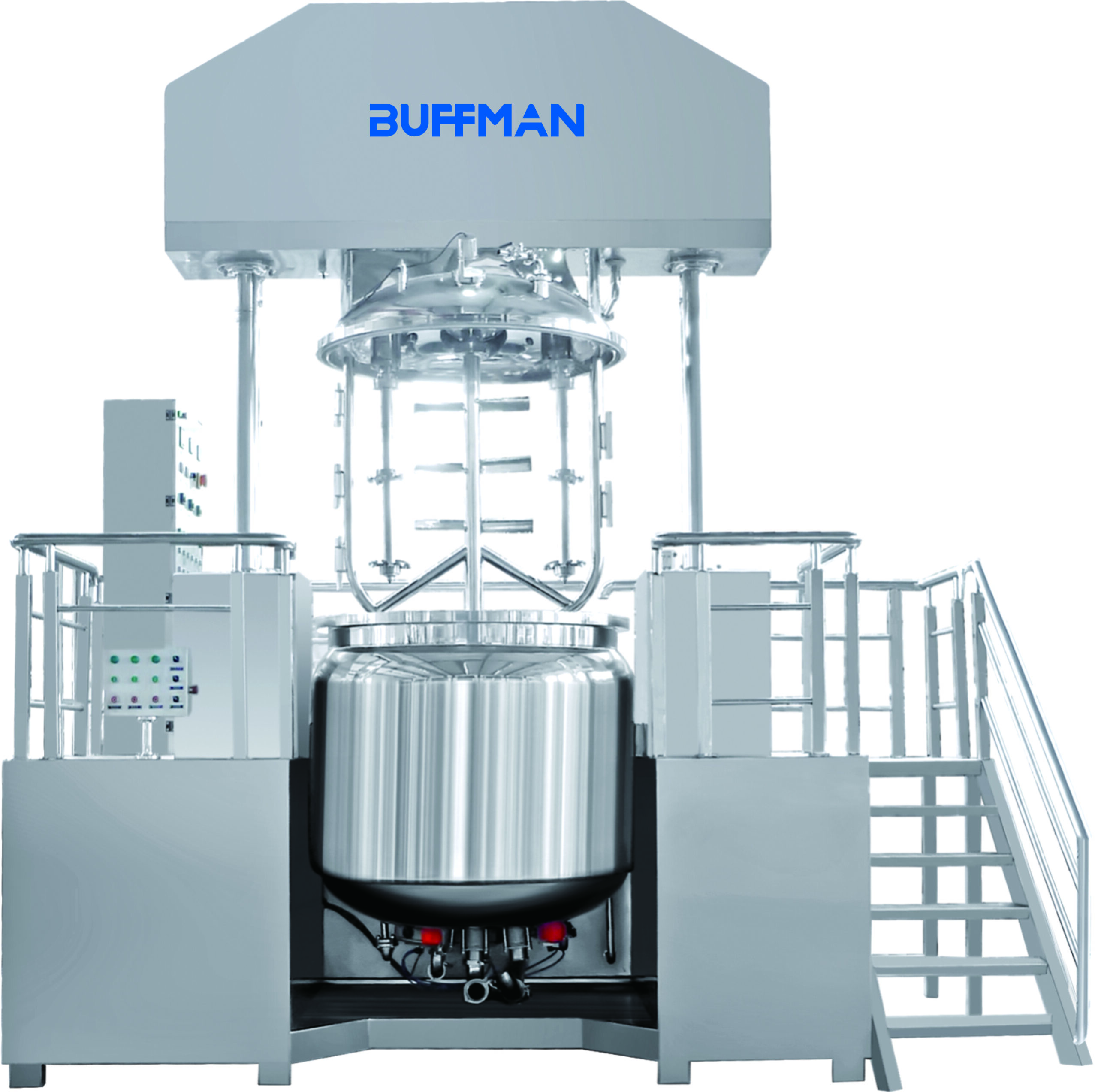
A toothpaste line has four jobs in order: wet out the binder, disperse the abrasive powders, de-aerate the paste under vacuum, then fill and seal the tube. The core machine is a vacuum paste mixer with a wall-scraping agitator plus a separate high-speed disperser — in Buffman’s range the BFM-YG, covering 500 L to 2,000 L working capacity at −0.097 MPa. Filling is a tube filler-sealer, aluminium or plastic depending on the pack. A complete line adds a water treatment unit, a paste storage tank and a cartoner.
What is actually inside the tube
Five ingredients decide how the machine has to be built. Everything else in a toothpaste formula is present at under 2% and mostly affects taste, not equipment.
| Ingredient group | Typical share | Examples | What it does to the machine |
|---|---|---|---|
| Abrasives | 40–55% | Calcium carbonate, silica, dicalcium phosphate | Drives the disperser power. Heavy powder loading is why the motor is far larger than on a cream emulsifier of the same volume. |
| Humectants | 20–30% | Sorbitol, glycerin, propylene glycol | Viscous liquid that must be pre-blended with the binder. Needs a jacketed vessel with controlled heat. |
| Binders | 0.8–2% | CMC, xanthan gum, carrageenan | The single most failure-prone step. Binder added dry forms fish-eye lumps that no amount of later mixing removes. |
| Surfactant | 1.5–3% | Sodium lauryl sulfate | Foams violently if sheared in air. This is the main reason the vessel runs under vacuum while dispersing. |
| Water, flavour, actives | balance | Purified water, menthol, fluoride | Water quality is a regulatory issue, not a mixing one — it usually means a dedicated RO or RO+EDI unit. |
Why this matters for buying: a cream emulsifier and a toothpaste mixer look similar from the outside — both are jacketed vacuum vessels with a stirrer. Inside they are different machines. A paste mixer needs a wall-scraping agitator that continuously lifts the product off the jacket, because a 50% solids paste will not flow to the wall on its own and will scorch. An emulsifier’s turbine does not do that.
The process, step by step
Six steps in a modern vacuum paste line. Steps 1 and 3 are where most plants lose batches.
- Disperse the binder in humectantCMC or xanthan is wetted into sorbitol or glycerin under high shear before any water is added. Doing this in the main vessel wastes a whole batch if it goes wrong; many plants use a separate small disperser for it.
- Charge liquids and heatHumectant blend, water, and any dissolved actives go into the vacuum vessel. Jacket temperature is held around 45–60 °C — warm enough to mobilise the binder, cool enough not to degrade the flavour that is added later.
- Add powders under shearAbrasives and thickeners are drawn in through the disperser at 960 r/min. Powder feed rate is the controlling variable: too fast and the paste forms dry pockets that later appear as gritty specks.
- Homogenise and de-aerate under vacuumThe vessel is pulled to −0.097 MPa and held while the wall-scraping agitator runs at 0–45 r/min. Air entrained by the powders and by the surfactant leaves the paste here. This step is what separates a glossy paste from one that looks chalky in a clear tube.
- Cool and add heat-sensitive ingredientsFlavour, some actives and colour are added below 40 °C with the agitator on slow, then the batch is held under vacuum briefly to strip the air those additions carry in.
- Discharge, store, fill and sealPaste is transferred to a storage tank, then to the tube filler. Aluminium tubes are crimp-folded; plastic tubes are sealed with hot air. Both need a paste that holds its shape, which is a property set back in step 3 and 4.
Why vacuum is not optional here
A cream can tolerate a little entrained air; a toothpaste cannot. Three reasons:
Density drift. A tube is filled by volume, but sold by net weight. Air bubbles change the density of the paste between batches, so the same fill volume gives a different declared weight. That is a labelling compliance problem, not a cosmetic one.
Visible porosity. In an opaque laminated tube nobody notices. In a clear or translucent tube, dispersed micro-bubbles read as a dull, chalky streak along the length of the pack.
Foam from the surfactant. SLS foams the moment it meets air under shear. Disperse it at atmospheric pressure and the vessel fills with foam faster than the pump can clear it, which limits how hard you can run the disperser.
The BFM-YG holds −0.097 MPa, which is close to the practical limit for a water-based system at room temperature. In practice the vacuum pump is sized at 4 to 7.5 kW across the model range because the load is not just the initial pull-down — it is continuously stripping air that the disperser keeps folding into the paste.
What a complete line contains
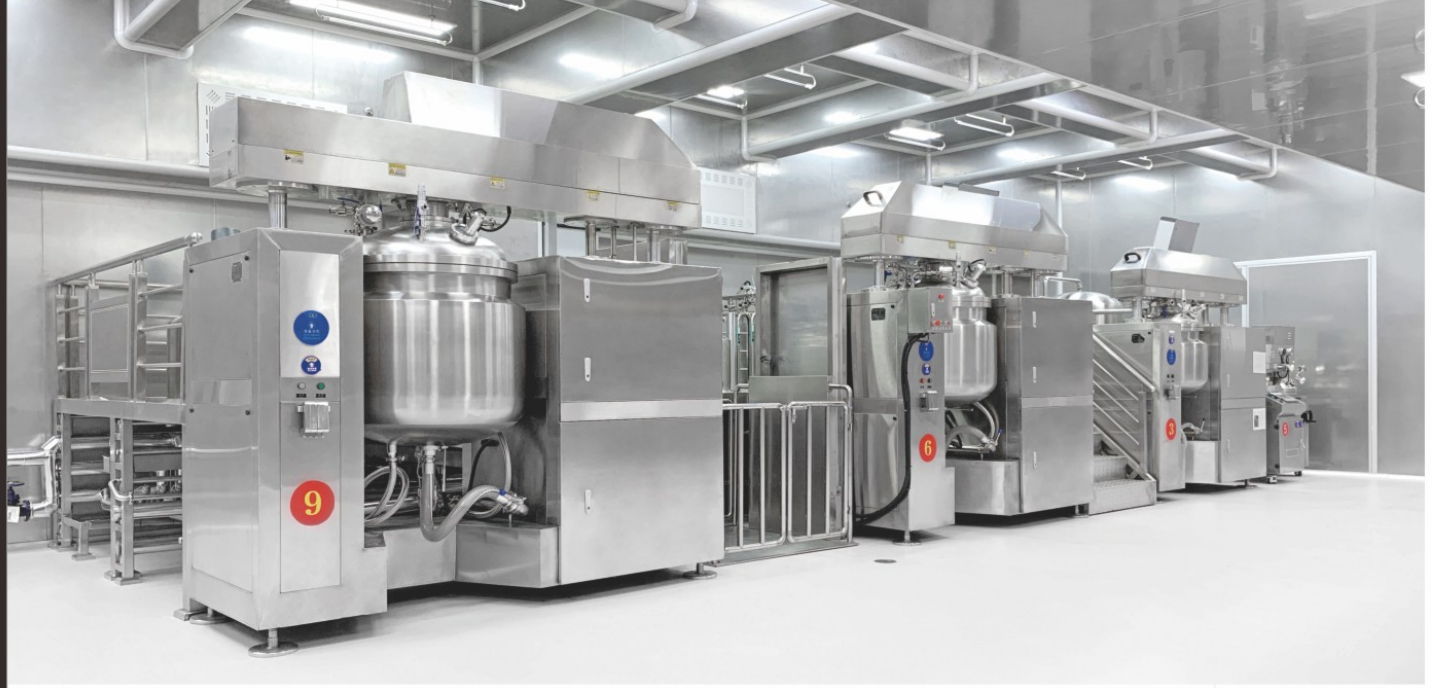
Six machine groups. The first and last are the ones buyers forget when budgeting.
| Stage | Machine | What it is for | Typical size |
|---|---|---|---|
| 1. Water | RO / RO+EDI water treatment | Purified water to pharmacopoeia or cosmetic grade. Microbial control starts here, not in the mixer. | 0.5–5 m³/h |
| 2. Binder | Pneumatic lifting disperser | Wets out CMC or xanthan in humectant before it reaches the main vessel. Small machine, saves whole batches. | 100–500 L |
| 3. Mixing | BFM-YG vacuum paste mixer | The core. Disperse powders, homogenise, de-aerate under vacuum. | 500–2,000 L |
| 4. Storage | Storage and buffer tank | Decouples mixing from filling so the filler is not idle during a batch. | 1–2 batch volumes |
| 5. Filling | Aluminium tube filler or plastic tube filler | Fill, seal, trim, code. Aluminium crimp-folds; plastic is hot-air sealed. | 1,800–4,800 tubes/h |
| 6. Packing | Cartoner, checkweigher, labeller | Not built by Buffman. Budget for it anyway. | — |
If you are also producing cream or gel in the same plant, that is a different machine family — see how to choose a vacuum homogenizing emulsifier and the comparison of mixing machine types.
BFM-YG technical parameters
Four models. Model number follows total vessel volume; working capacity is the usable batch size, which is lower.
| Model | Working capacity | Dispersing motor | Stirring motor | Dimensions (mm) | Vacuum pump (kW) | Ultimate vacuum (MPa) | Total power (kW) | ||||
|---|---|---|---|---|---|---|---|---|---|---|---|
| kW | r/min | kW | r/min | L | W | H | |||||
| BFM-YG700 | 500 L | 7.5 | 960 | 5.5 | 0–45 | 2900 | 1300 | 3000 | 4 | −0.097 | 39 |
| BFM-YG1300 | 1,000 L | 11 | 960 | 7.5 | 0–42 | 3150 | 1500 | 3350 | 5.5 | −0.097 | 49 |
| BFM-YG2000 | 1,300 L | 15 | 960 | 11 | 0–35 | 3100 | 1500 | 3500 | 5.5 | −0.097 | 64 |
| BFM-YG2500 | 2,000 L | 18.5 | 960 | 15 | 0–35 | 3200 | 1800 | 3700 | 7.5 | −0.097 | 84.5 |
Dimensions are the machine envelope and exclude the hydraulic or pneumatic lift where fitted. Check ceiling height and door width before ordering — the YG2500 is 3.7 m tall.
How to size the mixer
Three numbers decide it. Get them from your own production plan, not from a supplier’s recommendation.
1. Batch size in litres
Take your largest single batch and match it to working capacity, not to the model number. A BFM-YG1300 runs a 1,000 L batch. If your target sits between two models, take the larger: a paste at 50% solids does not behave like water in a partly filled vessel, and the wall scraper cannot reach the product if the level drops too low.
2. Batches per shift
A paste batch is not only mixing time. It is charge, disperse, vacuum-hold, cool, and discharge — and cooling is usually the longest single block because a jacketed vessel full of 50% solids transfers heat slowly. Plan on two to four batches per shift per vessel for medium capacity, and confirm the cooling time with your own product rather than a generic figure.
3. Tube output you need to feed
This is the check most plants skip. A plastic tube filler running at 3,000 tubes/h and a 100 g fill consumes 300 kg/h. A 1,000 L batch at a paste density of about 1.3–1.5 kg/L is roughly 1,300–1,500 kg, so one batch feeds that filler for four to five hours. If your filler runs two shifts, one mixer is not enough — you need either a second mixer or a buffer tank large enough to decouple them.
The density figure above is an estimate, not a specification. Paste density depends on your abrasive loading and on how much air the vacuum step removes. Weigh a litre of your own finished paste before you use any throughput calculation to buy equipment.
Five mistakes that show up in every toothpaste project
- Buying an emulsifier for pasteAn emulsifier’s turbine shears liquid; it does not scrape a 50% solids paste off a hot jacket. The batch burns on the wall within the first hour.
- Sizing on total volume instead of working capacityThe model number is the vessel volume. Ordering a YG2000 for a 2,000 L batch means running at 150% of working capacity.
- Adding binder dry to the main vesselLumps that form at this stage never fully disperse. Wet it out in humectant in a separate vessel first.
- Under-sizing the vacuum pumpPull-down is the easy part. The continuous load is stripping air the disperser keeps entraining, and a pump sized only for pull-down will lose vacuum mid-batch.
- Forgetting the ceiling and the doorA 3.7 m machine does not fit through a 3 m door, and it does not fit under a 3.4 m ceiling with the lift raised.
Frequently asked questions
Can a vacuum homogenizing emulsifier make toothpaste?
Not well. It will physically mix the ingredients, but it lacks a wall-scraping agitator, so a high-solids paste cannot be moved off the heated jacket and will overheat locally. Toothpaste needs a dedicated paste mixer with both a scraper and a disperser, such as the BFM-YG.
What vacuum level does toothpaste need?
The BFM-YG reaches −0.097 MPa. That is close to the practical ceiling for a water-based product at room temperature. Going deeper buys little; the limiting factor is usually how long you hold the vacuum, not how low you pull it.
How long does one batch take?
It depends mostly on cooling, which depends on your jacket water temperature and the paste’s solids loading. Rather than quote a generic number, ask for the cooling curve for your own formula — any supplier who gives a single figure for all products is guessing.
Do I need a separate disperser as well as the mixer?
For the binder, yes in most plants. Wetting out CMC or xanthan in a small separate vessel is far cheaper than losing a 1,000 L batch to fish-eye lumps. A pneumatic lifting disperser in the 100–500 L range is the usual choice.
Aluminium or plastic tubes — does that change the mixer?
Slightly. Aluminium accepts a stiffer paste because the tube is crimp-folded and supports itself. Laminated plastic tubes are sealed with hot air and need a paste that flows cleanly to the seal area without stringing. The mixer settings differ more than the machine does. See the tube filling comparison.
What do you need from me to quote a line?
Formula outline with solids loading, largest batch in litres, target tubes per hour and fill weight, available steam or electric heating, ceiling height and door width, and the certification your destination market requires.
Tell us the batch size and the tube
Send the formula outline and your target output, and we will come back with a machine size, a line layout and the utilities it needs. No obligation, and we will say plainly if a smaller machine would do the job.
- Largest batch in litres and batches per shift
- Solids loading and the abrasive you use
- Tube type, fill weight and tubes per hour
- Heating medium available on site
Sources and further reading
- Buffman Catalogue, Vacuum toothpaste making machine p.42–43 — BFM-YG700 to YG2500 technical parameters, quoted in the table above without rounding.
- Buffman Catalogue, Definition of vacuum emulsifier p.32 — shear and vacuum principle, applied here to the paste case.
- Buffman Catalogue, Automatic aluminium tube filling and sealing machine p.60 and plastic tube machine p.61 — filling capacity and speed figures used in the line table.
- Formulation composition ranges are general industry practice, not Buffman specifications. Confirm against your own formula before sizing any machine.
Related pages on this site:
BFM-YG toothpaste making machine ·
Aluminium tube filler ·
Plastic tube filler ·
Water treatment ·
How a purified water system is built ·
Personal care solutions ·
Vacuum emulsifier selection guide ·
Fixed, lifting or circulation