
Water Treatment Configurations for Cosmetic Plants
Four configurations get sold into cosmetic factories, and three of them are frequently the wrong one. The difference between them is not “how pure” — it is which impurity each stage removes and which one your formula and your certification actually care about.
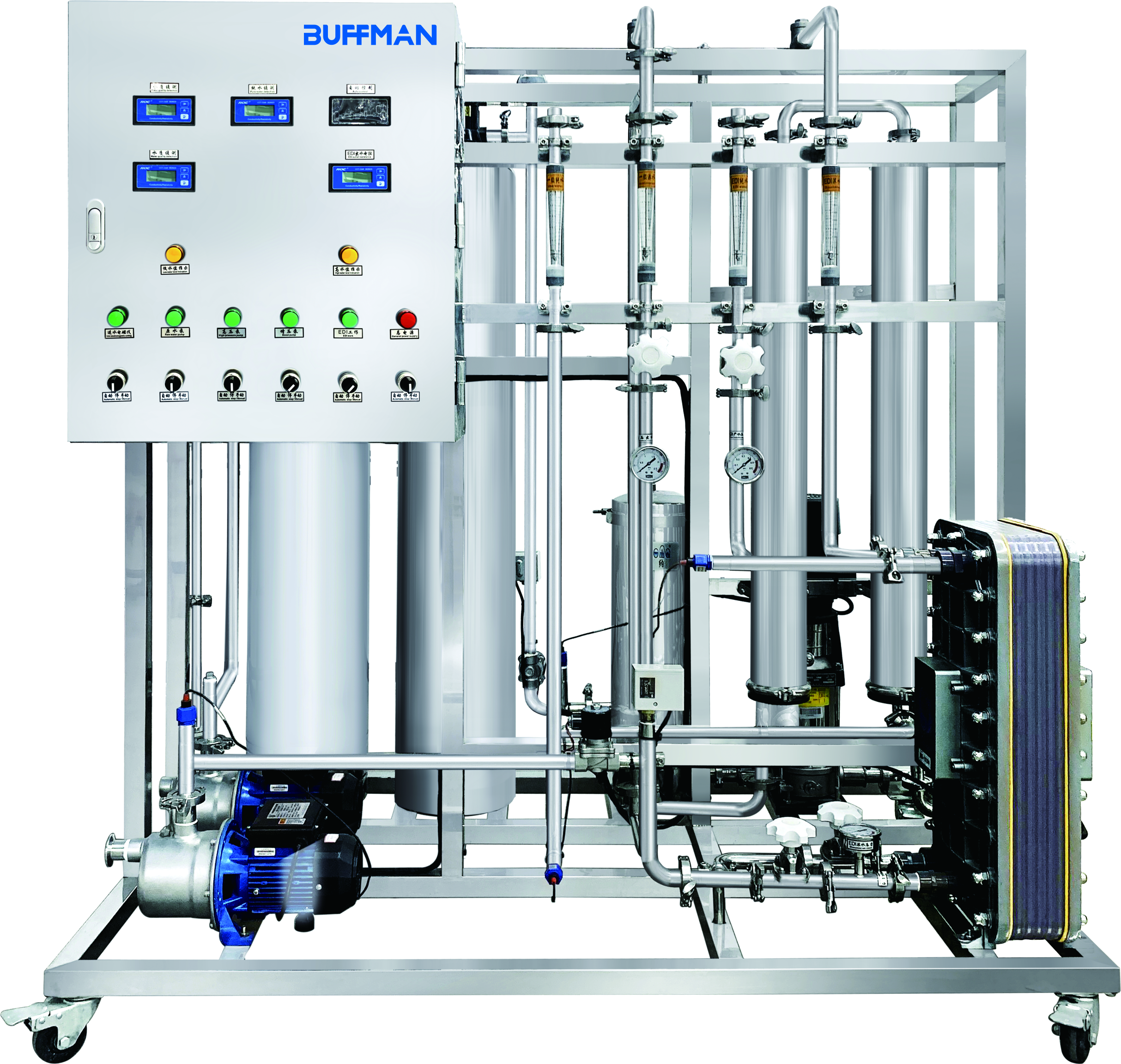
Most cosmetic plants need two-stage reverse osmosis, and only reach for EDI if the product or the certificate demands it. Single-stage RO is enough for cleaning water and utility use. Two-stage RO covers rinse water and most rinse-off cosmetics. Adding EDI takes conductivity below 0.5 µS/cm and removes the chemical regeneration step, which is what pharmaceutical and preservative-free products usually need. Ultrapure polishing — TOC reduction and ultrafiltration after EDI — is for injection-grade and electronics-grade water and is almost always over-specified in a cosmetic plant.
The four configurations, compared
Each one is a real product configuration, not a marketing tier. The jump from one to the next is a different set of hardware, not a bigger version of the same thing.
Single-stage RO
- Multi-media + carbon + 5 µm filter
- One RO pass, typically 1–4 m³/h
- No EDI, no polishing
- Recovery around 50–65%
For: equipment cleaning water, cooling make-up, boiler feed pretreatment, floor wash.
Config 2
Two-stage RO
- Same pretreatment, two RO passes in series
- Secondary permeate polished by the second membrane
- Recovery 55–80% depending on feed
- No chemicals to regenerate
For: rinse-off cosmetics, shampoo and body wash, general product make-up water, CIP final rinse.
Two-stage RO + EDI
- Adds an electrodeionization stack after the second pass
- Continuous operation, no acid/caustic regeneration
- Needs the RO outlet inside the EDI’s feed window
- Higher capital cost, lower chemical cost
For: leave-on skincare, preservative-reduced formulas, pharmaceutical ointments, oral care.
RO + EDI + polishing
- Adds TOC-reduction UV and ultrafiltration
- Continuous recirculation loop is mandatory
- Requires validated sanitisation and sampling
- Highest capital and operating cost
For: laboratory analysis, electronics, injection-grade water. Rarely needed for cosmetics.
Conductivity figures are typical achieved values, not guarantees. The output you get depends on your feed water — a plant on 800 µS/cm municipal water will not reach the same numbers as one on 200 µS/cm. Configurations 2 and 3 are what Buffman builds as the BFM/RO series; configurations 1 and 4 are described here because buyers ask about them.
What each stage actually removes
“Purer” is not a useful specification. The useful question is which contaminant matters for your product, and which stage handles it.
| Contaminant | Removed by | Why it matters in a cosmetic |
|---|---|---|
| Suspended solids, turbidity | Multi-media filtration | Fouls the RO membrane first, everything else second. Protection, not product quality. |
| Free chlorine | Activated carbon | Destroys polyamide RO membranes. If carbon is exhausted, the membrane fails within weeks, not months. |
| Dissolved salts (Ca, Mg, Na, Cl) | RO, both stages | Calcium and magnesium react with surfactants and reduce foaming; chloride drives corrosion in the vessel and the filling nozzles. |
| Residual ions after RO | EDI | Trace ions affect pH drift in a stored batch and can react with preservatives, which is why low-preservative formulas often specify deionised water. |
| Dissolved organics (TOC) | UV 185 nm + polishing | Organics are food for microbes. This is the number that matters for preservative efficacy, not conductivity. |
| Micro-organisms | UV 254 nm, ultrafiltration, and the loop itself | A water system that is clean at the outlet and stagnant in the pipe grows biofilm. Circulation and sanitisation do more than any single stage. |
| Dissolved gases (CO₂) | Membrane degassing, or pH adjustment before EDI | CO₂ passes RO and loads the EDI stack. It is the most common reason an EDI underperforms its datasheet. |
The single most overlooked stage is the activated carbon. It is the cheapest component in the whole system and the one that destroys the most expensive one. Carbon has a finite chlorine capacity — it does not fail visibly, it just stops absorbing, and the RO membrane behind it starts degrading. If a plant replaces membranes every 18 months and cannot explain why, the carbon is the first thing to test.
What the rules actually require
Buyers often arrive asking for “GMP water” without knowing that the phrase has no single definition. Three different regimes set three different bars:
Cosmetics GMP (ISO 22716). Requires that water used in manufacturing is fit for purpose and controlled, and that the system is monitored. It does not prescribe a conductivity number. The practical consequence: you must be able to show trending data, not just pass a one-off test.
Pharmaceutical purified water (USP / Ph. Eur. monographs). Sets measurable limits — conductivity, microbial counts, and for some grades TOC. If you make ointments or anything that crosses into a pharmaceutical claim, this is the bar, and it is what drives the EDI decision.
Destination-market cosmetic rules. The EU regime requires a product safety report; the water quality data feeds into it. Chinese cosmetic production rules require the water to meet potable standards at minimum, with purified water where the formula calls for it.
What this means for the purchase order: decide the regime before you decide the configuration. Writing “purified water to pharmacopoeia standard” into the spec adds an EDI stack, a validation file and a sampling regime. If the product only needs cosmetic-grade, that money buys nothing.
Three mismatches that show up again and again
- Buying EDI for a product that needs rinse waterThe most expensive mistake and the most common. EDI buys you sub-0.5 µS/cm water and no chemical regeneration. If your product is a rinse-off wash, the ionic load never mattered — you paid for a stack, a rectifier and a maintenance regime you did not need.
- Sizing on production volume instead of peak drawA 2 T/H unit does not deliver 2 T/H to a vessel that is being filled. It delivers 2 T/H minus what the loop, the CIP set and any simultaneous draw are taking. Plants that size on total daily consumption and forget simultaneous demand end up with a storage tank doing the work the RO should be doing — and stored water is where biofilm starts.
- Ignoring the feed water because “the machine handles it”The BFM/RO series is rated for feed conductivity up to 300 µS/cm. If your municipal supply runs 600 µS/cm in the dry season, the second stage cannot reach its stated output and the EDI stack will not stay in spec. A feed water analysis is the cheapest part of the project and the one most often skipped.
Four questions that decide the configuration
- What is the feed water?Get a full analysis, not just conductivity: hardness, chlorine, silica, iron, TOC and seasonal variation. Everything downstream is designed against this number.
- What is the water used for?Split it into buckets — product make-up, CIP final rinse, equipment wash, cooling make-up. They do not need the same quality, and piping them all from the EDI outlet is a waste.
- Which regime applies to the product?Cosmetic GMP, pharmaceutical monograph, or destination-market rule. This decides whether EDI is required or optional.
- What is the peak simultaneous draw?Not the daily total. The maximum litres per hour taken at once, including CIP. That number, plus a margin, is the unit size.
If you answer these four and the answer points to two-stage RO, that is a legitimate outcome and it is what most cosmetic plants should buy. The system design guide covers what happens after the configuration decision — pretreatment, storage, the circulation loop and how to validate it.
BFM/RO technical parameters
Eight models from 0.5 to 20 T/H. All are two-stage reverse osmosis with an EDI stage; the smaller models are commonly specified without EDI for rinse water duty.
| Model | Capacity (T/H) | Power (kW) | Recovery | Stage 1 outlet | Stage 2 outlet | EDI outlet |
|---|---|---|---|---|---|---|
| BFM/RO-500 | 0.5 | 0.75 | 55–80% | ≤10 µS/cm | 2–3 µS/cm | ≤0.5 µS/cm |
| BFM/RO-1000 | 1 | 2.2 | ||||
| BFM/RO-2000 | 2 | 4.0 | ||||
| BFM/RO-3000 | 3 | 5.5 | ||||
| BFM/RO-5000 | 5 | 7.5 | ||||
| BFM/RO-6000 | 6 | 7.5 | ||||
| BFM/RO-10000 | 10 | 11 | ||||
| BFM/RO-20000 | 20 | 15 |
The 5 T/H and 6 T/H models share the same 7.5 kW motor — the difference is membrane area, not drive power. That is worth knowing when a plant is deciding between them: the step up in output is cheap, the step up in power is not.
Frequently asked questions
Do I need EDI for a cosmetic factory?
Only if the product or the certificate requires it. Two-stage RO reaches 2–3 µS/cm, which satisfies most cosmetic GMP requirements. EDI becomes necessary when you make pharmaceutical ointments, when the formula is preservative-reduced, or when the product is leave-on skincare where trace ions affect stability.
What feed water quality does the BFM/RO series need?
Raw water conductivity of 300 µS/cm or below. That is not a wide window — many municipal supplies in industrial areas exceed it, particularly in the dry season. Get an analysis across seasons, not a single sample.
How much water does the system waste?
Recovery is 55–80%, so for every 100 litres drawn you get 55 to 80 litres of permeate and reject the rest. The recovery figure moves with feed quality and with how the system is set up; a higher recovery saves water but shortens membrane life. It is a trade-off, not a fixed number.
Is a storage tank and circulation loop always needed?
If the plant draws water intermittently, yes. The alternative is running the RO on demand, which is hard on membranes and gives you no buffer for CIP. But a tank that sits without circulation is worse than no tank — that is where biofilm forms.
How often do membranes need replacing?
There is no honest universal answer. It depends on feed water, pretreatment discipline and how often the plant lets the carbon exhaust. Any supplier who quotes a fixed interval without seeing your feed analysis is guessing. What can be said: if membranes fail in under 18 months, the cause is almost always pretreatment, not the membrane.
Can I add EDI later to a two-stage RO system?
Sometimes, and it is worth asking at the design stage rather than after installation. The EDI stack needs the RO outlet inside a specific conductivity and CO₂ window, and it needs floor space plus a DC power supply. Retrofitting is possible but rarely cheap.
Send the water analysis, get a configuration
A recent feed water analysis and your peak simultaneous draw are enough to say which of the four configurations fits, and whether EDI is required or optional for your market.
- Feed water analysis — conductivity, hardness, chlorine, silica, iron, TOC
- Peak simultaneous draw in m³/h, including CIP
- What the water is used for, split by purpose
- The regime that applies: cosmetic GMP, pharmacopoeia, or market-specific
Sources and further reading
- Buffman Catalogue, Secondary reverse osmosis pure water treatment p.56–57 — BFM/RO model range, capacity, power, recovery and outlet conductivity figures, reproduced without rounding.
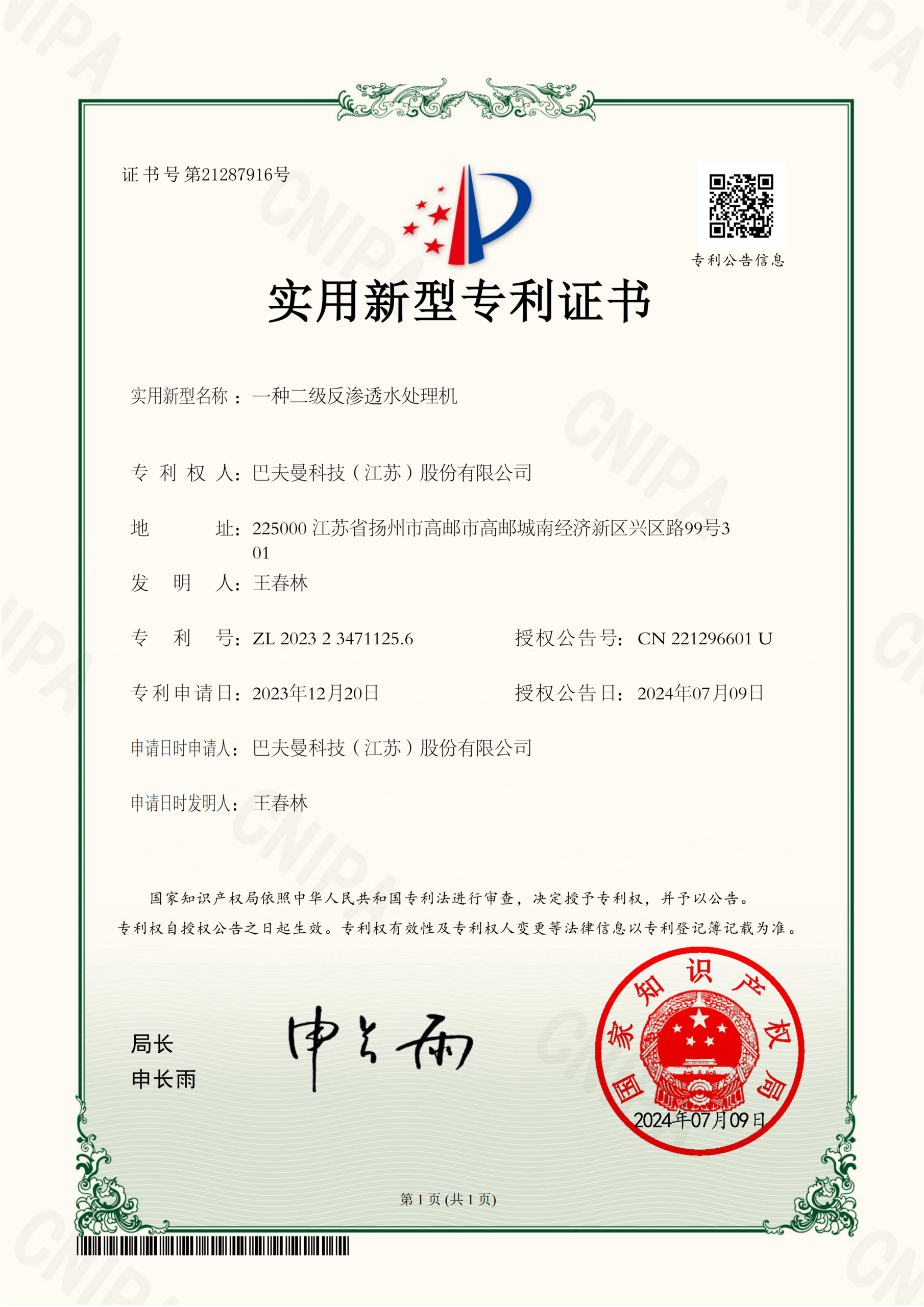
- Buffman utility model patent for a two-stage reverse osmosis water treatment unit — certificate reproduced on this page.
- Stage-by-stage contaminant removal is standard water-treatment engineering, not a Buffman specification.
- Regulatory descriptions are summaries of ISO 22716, the USP and Ph. Eur. purified water monographs and destination-market cosmetic rules. They are not legal advice — confirm the applicable text with your regulatory advisor.
Related pages on this site:
BFM/RO water treatment product page ·
Purified water system design and validation ·
Toothpaste process and equipment ·
Vacuum emulsifier selection guide ·
Vacuum emulsifier manufacturers directory ·
Pharmaceutical ointment solutions