Product Overview
The ultrapure water system is a high-end water treatment solution designed to produce ultrapure water with a resistivity of up to 18.2 MΩ·cm (25°C). It is widely used in fields requiring extremely stringent water quality standards. Through multi-stage purification processes, the system effectively removes impurities such as ions, organic matter, particles, microorganisms, and gases, ensuring water output meets the ultrapure requirements for laboratory analysis, electronics manufacturing, pharmaceutical production, precision instrument cleaning, and other critical applications.
Core Technologies & Processes
Pretreatment System
Utilizes multi-media filtration, activated carbon adsorption, and precision filtration to eliminate suspended solids, residual chlorine, colloids, and organic matter from feed water, protecting downstream core membrane components.
Reverse Osmosis (RO) Technology
Driven by high pressure, water molecules pass through a semi-permeable membrane, rejecting over 99% of dissolved salts, organics, and microorganisms, significantly reducing water conductivity.
Electrodeionization (EDI) Technology
Combines ion-exchange resins with electrodialysis to continuously remove residual ions without chemical regeneration, achieving deep desalination with high efficiency and eco-friendliness.
Post-Treatment Polishing
Equipped with ultrapure polishing columns (TOC removal, ultrafiltration) and UV sterilization modules to further reduce total organic carbon (TOC), particles, and microorganisms, ensuring compliance with ultrapure standards.
Product Advantages
High-Purity Output: Stable resistivity ≥18.2 MΩ·cm, TOC ≤5 ppb, compliant with ASTM, CLSI, and other international standards.
Smart Control: PLC/touchscreen HMI for real-time monitoring of water quality, flow, pressure, and other parameters; supports automatic flushing, fault alerts, and data logging.
Energy Efficiency: EDI replaces traditional mixed-bed systems, eliminating acid/alkali consumption and reducing operational costs by over 30%.
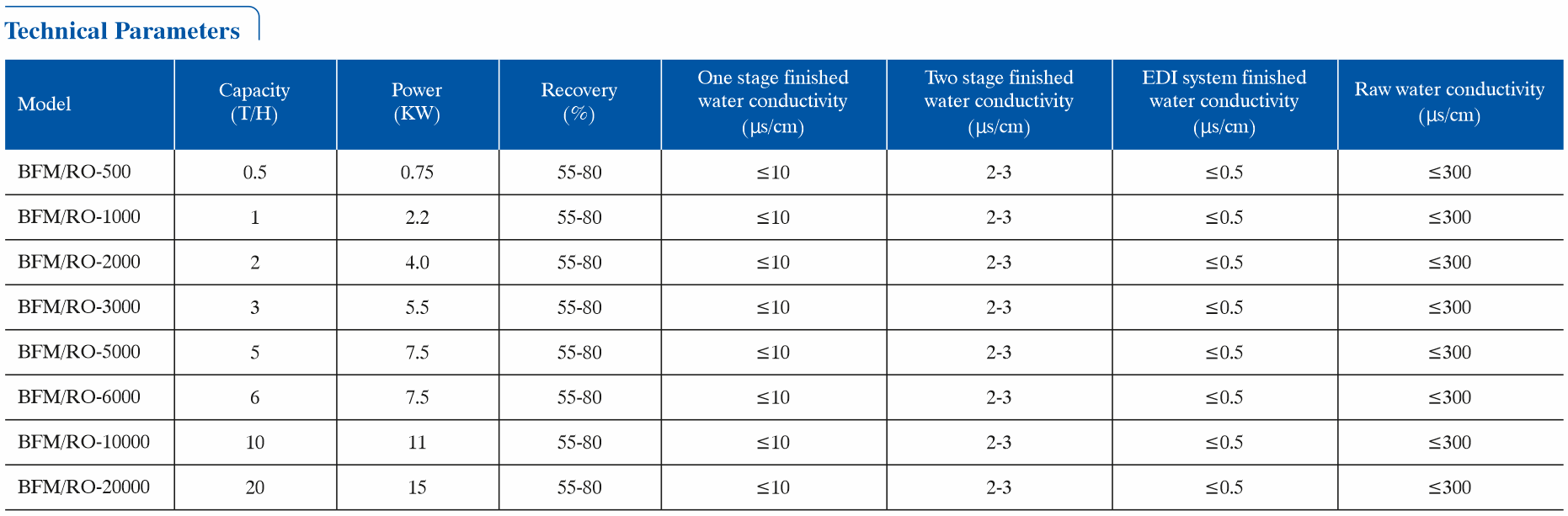
Modular Design: Flexible configurations for varying output demands (0.5 L/h to tens of tons/hour), easy maintenance, and scalable expansion.
Reliability: Core components from global brands (e.g., DOW membranes, Siemens EDI) ensure long lifespan and low failure rates.
Applications
Electronics: Semiconductor wafer cleaning, photovoltaic cell production, precision PCB manufacturing.
Pharma/Biotech: Water for Injection (WFI), biotech reagent preparation, cell culture, and drug R&D.
Laboratories: High-end analytical instruments (ICP-MS, HPLC, GC) requiring ultrapure water.
Others: Nuclear power plant cooling, optical lens processing, electroplating industries.